
Can’t Get Out of Mold Yet? How to Reduce Mold Exposure when You Have Mast Cell Activation Syndrome
If you have Mast Cell Activation Syndrome (MCAS), then Mold Toxicity might be playing a bigger role than you realize. And if you’re reading this, you’ve at least thought about it. Which is an important first step!
Mold is the #1 root cause we see behind MCAS, sensitivities, and immune and nervous system dysregulation.
And one of the most common places people get stuck.
We get it. There are many challenges when it comes to environmental mold and your health.
So, this post is for you if:
- You know you have mold in your environment but can’t remediate or move yet
- You suspect something is off in your environment but are still piecing it together
- You are brand new to the idea that mold and MCAS are frequently connected
- Or you have already moved or remediated and just want some ideas on maintaining your new space
Whatever stage you’re at, you’ll find practical tips to help you reduce your exposure and support your body. Even when you are sensitive.
In this post we will cover:
- The connection between Mold Toxicity and MCAS
- What to avoid doing with mold (these things can make the problem worse)
- Tips for reducing mold exposure (while you work towards moving or remediating if you are currently in mold)
- The best products our clinic recommends for sensitive people
- How to support your body while you’re still exposed to mold
Let’s get started!
It’s important you know that this blog post is for educational and informational purposes. It’s not meant to treat any health condition or to be prescriptive for anyone. If you have any medical condition, it is critical you work under the care and guidance of a licensed medical healthcare provider.
What Is Mold Toxicity?
Mold Toxicity can happen when you are exposed to mold spores and mycotoxins (mold gases).
You can breath mold spores and mycotoxins in. Eat or drink them. Or even absorb mycotoxins through your skin.
And they can easily build up over time.
Mold toxins in your body can be from past or current exposures.
Related Post: Testing for Mycotoxins and Mold in Your Body
Because mold only needs a moisture source and a little time to begin growing, even a small water leak can become a significant problem. Water damage in buildings can quickly affect your indoor air quality.
And a lot of mold growth is completely hidden.
Mold can grow on drywall, ceiling tiles, porous materials like carpet or cloth, wood, and anywhere with excess moisture. We even had a client discover the mold that made her sick was growing in tiny dust particles on her bathroom wallpaper! Her house was clean.
It can even grow inside you (mold colonization).
If you or other people in your home are sick and you can’t figure out why, mold and mycotoxins are a very good place to start looking closer.
Let’s look at the connection with mast cells and sensitivities next.
MCAS and Mold Toxicity: The Connection
As you just read, if you have Mast Cell Activation Syndrome and Histamine Intolerance or other sensitivities, mold is worth looking at very carefully.
With MCAS, your mast cells are hypersensitive and overreacting to triggers like:
- Foods
- Chemicals
- Allergens
- Environmental toxins
- And more!
Mold spores, and the mycotoxins they release, are potent mast cell triggers.
They drive inflammation, dysregulate your immune system, and can keep your nervous system locked in a chronic stress response.
The health risks of mold exposure are well-documented in studies. And for people with MCAS, even low-level mold exposure can produce health problems like:
- Allergic reactions
- Asthma attacks
- Congestion
- Brain fog
- Sensitivities (food, chemicals, supplements, etc)
- Insomnia
- Hormone imbalances
- Gut issues / Leaky Gut
Related Post: Mold Toxicity Symptoms
We know learning that mold could be behind your symptoms can feel overwhelming. Take a breath. You don’t have to do everything at once.
Even one small change can start to move the needle. Just take it one step at a time.
Let’s take a look at your first steps.
Taking a Closer Look at Environmental Mold
Our expertise here at the Mast Cell 360 Clinic is the body. But we see Mold Toxicity as part of what’s driving illness in more than 95% of our clients. So, we do have some trusted resources we can share to help you get started cleaning up your environment.
If you suspect mold in your home, working with a qualified Indoor Environmental Professional (IEP) who is familiar with chronic illness and sensitivities is the ideal next step.
In our post, Testing Your Home for Mold with MCAS, you’ll find:
- The lower-cost DIY test we recommend starting with
- Guidance on how to find and choose a good IEP
- And environmental mold resources we trust
While you’re investigating environmental mold or working towards remediation or moving, there is still a lot you can do to reduce your mold exposure and support your health.
Should I Stay or Should I Go?
We often get asked if you must move if you have mold. Honestly, it depends on many factors like how ill you are, how big the mold problem is, whether you rent or own your home, and what’s realistic for your situation.
If you’re not sure if your home is part of the problem, going away for a few days to see how you feel can be helpful.
If you are very sick and know you have mold or strongly suspect it, you certainly want to limit your exposure as much as possible. And that may mean finding another place to stay, at least temporarily, while you figure out the mold piece at home.
Many of our clients are able to return to their homes after successful remediations.
Other times it may make more sense to move. For example, if you rent or there are very extensive and costly remediations. And it’s best to consult with an environmental professional to help make those decisions.
We also realize it’s not always possible to move or remediate right away. It takes time.
So, while you work on figuring out your environmental mold piece, here are some tips to help you minimize mold exposure and support your body.
How to Reduce Mold Exposure at Home
Whether you’re just starting to investigate, waiting on remediation or moving, or figuring out your next steps somewhere in between, these practical tips can help reduce your exposure and support your body right now.
They can also be used to help maintain a new living space and keep it mold free!
What to Avoid When You Suspect Mold
Before we get into what to do, let’s cover a few things to avoid.
Because some things can make the mold problem worse. And that’s particularly bad news if you have MCAS.
Things to avoid include:
- Downplaying mold – mold is incredibly toxic. And standard home inspections often miss it. Or underestimate its impact on people with chronic illness. If you suspect mold or have been told you have mold “but it’s not a problem,” don’t stop at a basic inspection. See our Home Mold Testing post for more information and tips to find qualified help.
- Ozone – it’s a mast cell trigger and mold left after ozone is more aggressive.
- Painting over mold – like bleach, this doesn’t solve the problem. The mold is still there.
- DIY mold remediation – disturbing or uncovering mold without proper containment can spread microscopic mold spores and mycotoxins and make things worse. And remediation work is hard to do yourself without lots of exposure. It’s usually best to leave mold removal to a knowledgeable professional, especially if it’s a bigger area.
- Bleach – this adds moisture, makes mold invisible but not gone, and can make the problem worse. Mold often goes much deeper than what you see. If you have surface mold to wipe up or issues with drains, 12% hydrogen peroxide is a safer option. But for everyday cleaning, we have some even better options we’ll talk about in a moment.
- Harsh chemical cleaners or “fogging” agents – these can really trigger flares with MCAS! And we’ve had many people report reacting to Benefact, even though it is plant based. You want to make sure to use gentle and effective cleaners.
Note: Some “mold cleaning companies” will tell you they can just fog or spray to get rid of mold instead of needing to remove materials. This is simply not true. And it’s not a substitute for real remediation.
Now let’s look at what you can do to help.
Moisture Control First
Mold likes to grow in damp, dark spaces. To prevent or slow mold growth:
- Keep indoor humidity levels between 40–50%. Use an inexpensive hygrometer in each room to monitor levels.
- Add a dehumidifier if your humidity is regularly over 50%. And don’t forget to clean the bucket weekly!
- Run exhaust fans in high humidity areas like bathrooms or open windows when showering or bathing.
- Fix water leaks immediately and thoroughly dry out any wet materials or remove them. Mold can grow within 24 to 48 hours of a moisture event.
- Add drip pans below plumbing under sinks. And don’t overcrowd cabinet storage, so you can see if a pipe is leaking.
Now let’s look at tips for minimizing exposure if you do have mold.
Limit Your Time in Affected Areas
Reducing how much time you spend near the source matters.
- Stay out of the most affected areas of your home. If the mold problem is in the basement, don’t go down there. If it’s in one room, avoid it.
- Seal off any known water damaged areas with plastic sheeting until they can be properly addressed.
- Spend more time outside or with family or friends when you can. Anything that reduces your total daily exposure helps.
Filter and Clean Your Air
You breathe over 20,000 times a day. So, the fewer toxins in your air, the better.
The solution to pollution is dilution.
For cleaner air we recommend:
- Using filters:
- Air Doctor for filtration. It captures particles down to 0.003 microns, the size of mycotoxins.
- HypoAir Air Angel for local air purification.
- Use coupon code MASTCELL360 for 10% off!
- HypoAir also has a whole house unit for air conditioning / HVAC systems.
- Open windows when outdoor air quality is good, to improve air circulation and bring in fresh air. Use an app like IQAir to check local air quality before opening up.
- Fogging is one of the easiest and most effective ways to lower the mold and mycotoxins in your air. You’ll read more about that in just a moment.
Keep Surfaces Clean
Mold spores and mycotoxins settle into household dust. So regular cleaning makes a real difference.
To keep dust and mold down:
- Dust regularly with a damp microfiber cloth or disposable towel. Wipe furniture, hard surfaces, ceiling fans, windowsills, floors, and baseboards to ensure mold cleanup.
- Vacuum with a HEPA vacuum only. Standard vacuums blow mold spores back into the air.
- Wash bed linens weekly (or more) in the hottest water your materials can tolerate. Wash your bath towels with each use.
- Remove shoes at the door. Studies consistently show that shoes bring allergens and spores throughout the home.
Foundational Body Support for Mold Exposure
While you’re working on reducing mold in the environment around you, don’t forget to support your body from the inside too.
Mold is a toxin. Your body needs to process and move it out.
Some basic tips to keep these processes supported and moving goes a long way.
- Hydrate – drink at least half your body weight in ounces of filtered water daily. Water is a natural antihistamine and plays a big part in how your body detoxes.
- Prioritize daily bowel movements – this is the primary route mycotoxins exit your body. No binders until this is consistent.
- Cover your food and water – if you’re still in mold, just keeping a lid or covering on food and water can help reduce the mold you ingest. You don’t need to cover your plate while you’re eating, just don’t leave food or drinks sitting out without a cover.
- Protect sleep – good sleep hygiene matters more than ever when you are trying to recover
- Related Post: Supplements for Insomnia
- Gentle movement (as tolerated) – even a short walk supports lymphatic flow and detox
- Nervous system support – Primal Trust and vagal toning practices can help calm mast cells and start healing
Things like fiber, binders, and nasal sprays can also be supportive. You can read more about detox support in our mold detox post.
But prevention is always better than needing to remove toxins.
Here are our favorite products that help reduce mold and mycotoxins in your environment and on your body. So your body doesn’t have to work so hard.
EC3: Gentle and Effective Products for Reducing Mold
Finding products that actually remove mold AND don’t trigger reactions when you have Mast Cell Activation Syndrome is a challenge. We’ve tested a lot of options over the years.
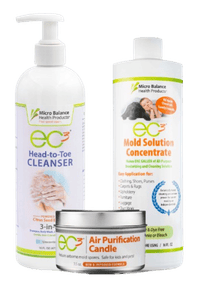
EC3 by Micro Balance are the ones our team keeps coming back to. We recommend them to our clients, too. They are gentle and they actually work!
We’ve put our favorites together in a convenient bundle:
- EC3 Head-to-Toe Cleanser – a daily wash that removes mold from hair and sensitive skin. It’s good for pollen and other triggers, too!
- EC3 Air Purification Candles – for gentle air purification. Burning a candle for 30 minutes before you go to bed can help clear the air. Yes, we were skeptical, too. But they really do work.
- EC3 Mold Solution Concentrate – for cleaning, laundry, fogging, misting, and more. Instructions for use are on their website and the bottle.
- Dilute in a spray bottle for cleaning hard surfaces
- Use for fogging and misting to pull mold and mycotoxins out of the air (really helpful!).
- Test a small area first (like 1 bathroom). With heavier applications, plan on leaving for several hours to let it settle. Then you can HEPA vacuum and wipe up everything it pulls out of the air. If you are very sensitive, have someone help you do this.
- Many people fin this helpful every few weeks while still being exposed. And they feel a lightening of symptoms after fogging. You can use symptom return as a gauge for how often to fog.
- If you’re testing your home, do the ERMI before you fog or mist!
>>> Click Here to Get the Mast Cell 360 Bundle and save 10% with code MC10
Use these EC3 products:
- As part of a regular routine while you’re still in mold
- As part of your healthy home maintenance after you remediate or move
- When you return from visiting moldy places (stores, offices, friends’ homes, church)
- Anytime you travel
Even the hypersensitive people on our team have done very well with them. And most people in our sensitive community have tolerated them well, too.
Since it’s possible to react to just about anything with MCAS, we still recommend starting small.
Spray a little EC3 Concentrate on a paper towel and wipe down one area before you try misting. Try misting before you try fogging. Or start with a little of the candles or body cleanser first.
Want to learn more about EC3 products by Micro Balance and how they work? Watch our live here:
Mold is a big piece of the MCAS puzzle for many people. In our clinic, nearly everyone.
But we also want you to know we see people detox and recover every day.
Start where you are. Do what you can. Every step you take to reduce mold exposure matters. It’s meaningful support for your body.
Did these tips help you learn how to reduce mold exposure? What helped you most? Let us know in the comments below.
More Mold and Mast Cell Activation Syndrome Resources
- Mold Toxicity Symptoms with MCAS
- Mast Cell Activation Syndrome (MCAS) Symptoms Survey
- Histamine Intolerance vs MCAS: Do You Have One or Both?
- Testing Mycotoxins and Mold in Your Body
- Testing Your Home for Mold
- How to Gently Detox Your Body from Mold and Mycotoxins
- Precision Mold Master Class
Some links in this website are affiliate links, which means Mast Cell 360 may make a very small commission if you purchase through the link. It never costs you any more to purchase through the links, and we try to find the best deals we can. We only recommend products that we love and use personally or use in the Mast Cell 360 practice. Any commissions help support the newsletter, website, and ongoing research so Mast Cell 360 can continue to offer you free tips, recipes, and info. Thank you for your support!
References
Centers for Disease Control and Prevention. (2024, September 26). Mold. U.S. Department of Health & Human Services. https://www.cdc.gov/mold-health/about/index.html
Gerba, C. P., Wilkes, J., & Wuollet, A. (2008). Bacterial contamination of shoes and transfer to floors. Cleaning Industry Research Institute (CIRI). https://www.iscr.org
Theoharides, T. C., Kavalioti, M., & Martinotti, S. (2018). Effects of mycotoxins on neuropsychiatric symptoms and immune processes. Clinical Therapeutics, 40(6), 903–917. https://www.clinicaltherapeutics.com/article/S0149-2918(18)30229-7/fulltext
Empting, L. D. (2009). Neurologic and neuropsychiatric syndrome features of mold and mycotoxin exposure. Toxicology and Industrial Health, 25(9–10), 577–581. https://pubmed.ncbi.nlm.nih.gov/19854819/
Fisk, W. J., Lei-Gomez, Q., & Mendell, M. J. (2007). Meta-analyses of the associations of respiratory health effects with dampness and mold in homes. Indoor Air, 17(4), 284–296. https://doi.org/10.1111/j.1600-0668.2007.00475.x
Jedrychowski, W., et al. (2011). Impact of mold on mast cell-cytokine immune response. PubMed. https://pubmed.ncbi.nlm.nih.gov/30043558/
RealTime Labs. (n.d.). EC3 air purification candle efficacy testing [Independent laboratory report]. Commissioned by Micro Balance Health Products. https://microbalancehealthproducts.com/products/ec3-air-purification-candle.html#images-7


Add A Comment