
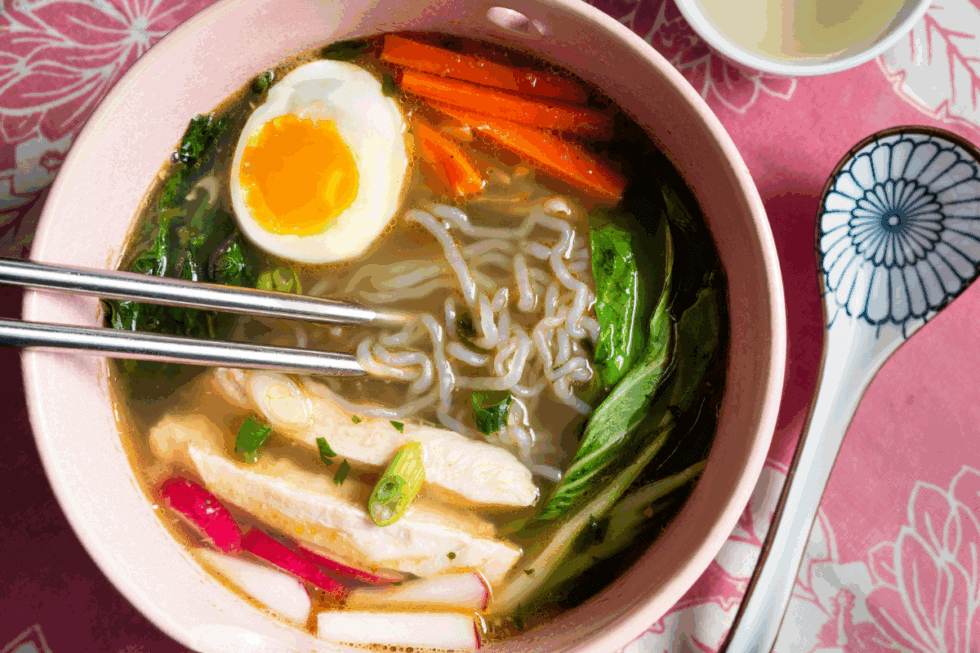
Low Histamine Miracle Noodle Ramen (also Low Oxalate, Low Lectin)
Miracle Noodle ramen tops our list of low histamine comfort food favorites.
Low histamine recipes can be every bit as yummy as their high histamine counterparts!
Our version of this Japanese inspired noodle soup starts with a low histamine broth.
We add sesame oil, garlic, fresh ginger, onions, fresh herbs, stir fried veggies and chicken to build flavor.
To finish, you can opt for a soft-boiled egg (if tolerated) and additional fresh herbs.
A perfect dish to warm up on a chilly day! (Or any day!)
This recipe is:
- Low histamine
- Low oxalate
- Low lectin
- Dairy free
- Gluten free
- Vegetarian option
Miracle Noodle Ramen Recipe: Why Choose Miracle Noodles?
Before you change your diet on your own, make sure you’re working with a healthcare practitioner who can help you with this. Never limit foods unnecessarily, and always have a licensed medical provider who is supervising your case.
When it comes to ramen, you might think of the rectangle of wavy noodles you buy at the store.
Or maybe instant ramen cups with noodles and a few dehydrated vegetables.
But ramen is so much more!
People often use ramen to refer to both the soup itself and the noodles used in it.
The ramen noodle is a wheat-based noodle.
You may know that wheat and wheat-based products may not be right for you if you have:
- Histamine Intolerance
- Gluten Intolerance
- Lectin Intolerance
- FODMAP Intolerance
Related Article: Are Wheat and Gluten Really Mast Cell and Histamine Triggers?
But do you have other food intolerances?
Here’s a quick breakdown of common alternatives to wheat noodles. You’ll see which intolerances each may not be right for.
Buckwheat – may not be suitable with Lectin Intolerance, Oxalate Intolerance
Rice – may not be suitable with Lectin Intolerance, Oxalate Intolerance
Potato – may not be suitable with Lectin Intolerance, Oxalate Intolerance
Sweet Potato – may not be suitable with Oxalate Intolerance, Salicylate Intolerance
And what about vegetable noodles?
Vegetable noodles are simply spiralized strands of various vegetables.
Veggie noodles can be made from:
- Zucchini — high lectin, high salicylate
- Carrots – moderate to high oxalate, moderate salicylate
- Beets – high oxalate, high salicylate, high FODMAP
- Rutabaga – typically ok
If you are super sensitive, you may be wondering if any of these will work for you!
And if you are just starting out or very sensitive, it may work best to make veggie noodles with a spiralizer from something you tolerate well, like rutabaga.
But if you’re a little further along, there is one store-bought noodle we’ve found works well for many people with various food intolerances.
Miracle Noodles.
What Are Miracle Noodles?
Miracle Noodles is the brand name for a type of noodle made from the konjac plant.
Konjac is a root vegetable native to Eastern and Southeastern Asia.
More specifically, Miracle Noodles are made with flour made from the konjac plant. You’ll often see this listed as konjac flour, konjaku flour, or even konjac powder.
The noodles made from this flour can be called konjac noodles, shirataki noodles, or by the name brand. In this case, Miracle Noodles.
Miracle Noodles come in various shapes like:
- Angel hair
- Fettucine
- Spaghetti
We used the spaghetti shape for this recipe.
When it comes to konjac noodles, we like this one:
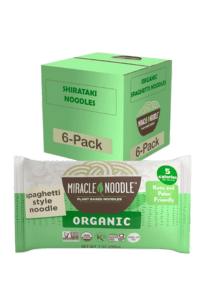
>>> Click here to buy Miracle Noodles
It has only 3 ingredients:
- Konjac Flour
- Purified Water
- Citric Acid (more on this recent addition in a minute)
We’ve used these low-carb noodles in recipes like healthy pad Thai. Our staff, clients, and readers have typically had good success with this brand.
When we first tried these noodles, they used calcium hydroxide as a preservative. But they recently swapped that out for citric acid in the liquid the noodles are stored in.
It isn’t part of the noodles. And we’ve had good luck simply rinsing the liquid off the noodles well!
That may be ok for some people, but if you are sensitive, note that citric acid can act as a histamine liberator.
If you’re very sensitive, you might want to start with just a bite of plain, rinsed noodles to see how you do first. Or make noodles out of a vegetable you do well with (like rutabaga) for your ramen instead.
Here’s another thing to know about Miracle Noodles.
Do These Smell Odd?
Some people detect a fishy odor when they first open the noodle package.
But others, including several of our staff, weren’t bothered by any smell at all.
Don’t worry, though. The noodles aren’t off.
And, if you are one of the people who think they do smell fishy, they won’t continue to smell that way. They don’t taste like fish either.
In fact, Miracle Noodles don’t have much flavor. But they take on the flavors they are cooked in very well.
That makes them versatile to use in everything from Italian spaghetti to Asian noodle dishes like ramen or pad Thai.
Most brands of konjac noodles suggest taking them out of the package and rinsing them between 15 seconds to 1 minute under cold water before cooking.
We suggest using purified water since noodles are absorbent.
Related Article: AquaTru Water Filter Review
Before we get to the recipe, here are some helpful tidbits to consider before preparing the low histamine Miracle Noodle ramen.
What To Know and Expect from the Miracle Noodle Ramen Recipe
When you get right down to it, ramen is made up of a variation of three components.
Ramen soup is made of:
- Broth
- Noodles
- Toppings such as fresh meats and fresh veggies
The Broth
Our low histamine ramen broth starts with either our low histamine meat broth or our low histamine veggie broth.
To make this recipe vegetarian, start with veggie broth.
TIP: If you are working with frozen broth, thaw it in a separate pot before getting started.
To the base broth, you’ll add sesame oil, onions, garlic, ginger, and fresh herbs to build even more umami flavor.
We used cilantro. But you can use parsley if you don’t like cilantro. Or you can use both.
Here are some high histamine ingredients to steer clear of when making your broth.
- Dashi
- Bone Broth
- Miso
- Soy Sauce
- Fish Sauce
- Coconut Aminos
The Noodles
We’ve used Miracle Noodles in this recipe. You read a little about them in the previous section.
Wheat noodles are toothsome and starchy.
Miracle noodles are more akin to rice noodles.
They’re more translucent than wheat noodles. Some people have described them as somewhat gelatinous in texture.
We used the spaghetti style.
It’s closest in shape and has a nice “slurpability”. Always important when eating ramen!
The Toppings
You can top ramen with anything!
Here’s what we did, along with some helpful tips for preparing the toppings.
Protein
You can use any protein you prefer. We opted for chicken.
Start with low histamine protein. Northstar Bison or White Oak Pastures have great options.
Related Article: The Best Low Histamine Meat and Seafood Options
We cooked the chicken in sesame oil for more flavor.
We also added a soft-boiled egg at the end.
Eggs will add extra protein to this dish.
But you may want to omit the egg if you’re sensitive and still in phase 1 of the low histamine diet.
Eggs aren’t high histamine. But for highly sensitive people, it’s one thing we typically hold off on until symptoms are under control.
You can always take an Egg Zoomer test to see if eggs are an issue for you.
If you do opt for the egg, make sure to get it in a cold-water bath as soon as it’s done cooking. This stops the cooking process and helps cool the egg so you can peel it.
6 minutes gives you firm whites with a runny yolk.
7 minutes gives you firm whites with a jammy yolk.
Veggies
When it comes to veggie toppings, many recipes say to blanch the vegetables.
We did a light stir fry instead. This method added more flavor, created fewer dishes to wash, and overall was just less complicated to manage.
During the stir fry, we added the vegetables in a specific order, one at a time.
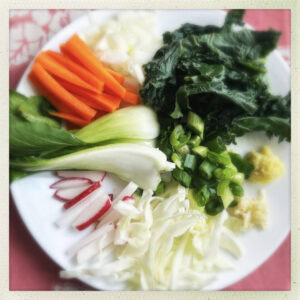
This allowed the firmer carrots to cook longer, while the cabbage, kale, and bok choy tenderized but didn’t get soggy.
Ramen is often served with the topping ingredients compartmentalized.
We used a large skillet during the stir fry and were able to keep the vegetables separate for the most part.
If you want to keep the vegetables separate, you can. But this isn’t strictly necessary.
It tastes the same either way. It’s your preference.
Speaking of veggies, these are common in ramen recipes. You’ll read more about why not all are right for different food intolerances below:
- Bean Sprouts
- Carrots
- Spinach
- Onion
- Mushrooms
- Peas
From the list above, we used carrots and onions.
We only used ¼ cup of carrots for the whole recipe. At 2 servings, this recipe is considered lower oxalate.
However, if you are very sensitive, omit the carrots.
Or you can add more if Oxalate Intolerance isn’t an issue for you.
We skipped high lectin foods like bean sprouts and peas. Instead, we used cabbage for a tender crunch.
And we used kale and bok choy in place of high histamine spinach for a light bitterness and texture variation.
And we didn’t have an exact replacement for high histamine mushrooms, but you’ll get plenty of umami from the other ingredients.
We topped the soup with raw radishes and added more fresh herbs and green onions to garnish.
A Note for Prepping the Veggies
In the recipe, you’ll see that some of the vegetables are julienned.
This just means you’ll cut them up into small pieces that resemble matchsticks.
You can do an internet search for techniques on how to do this. But don’t worry about perfection. Just cut them thin and as evenly as possible.
TIP: We found it was helpful to have all the produce washed and prepped before beginning to cook. You can start cutting while your egg is boiling to save some time.
Is your mouth watering yet?
Here’s the recipe.
What to Serve with Low Histamine Miracle Noodle Ramen
- Chinese Broccolini Recipe Inspired by Gai Lan Chinese Broccoli – Low Histamine, Low Oxalate, Low Lectin, Low FODMAP
- Tulsi Rose Tea Recipe – Low Histamine, Low Oxalate, Low Lectin, Low FODMAP
Low Histamine Miracle Noodle Ramen
Equipment
- Sharp Knife
- Garlic Press optional
- Large Pot
- Medium Mixing Bowl if making soft boiled eggs
- Straining Spoon if making soft boiled eggs
- Brieftons Spiralizer if making your own veggie noodles instead
Ingredients
- 2 Eggs optional
- 3 Tablespoons Toasted Sesame Oil divided
- ½ cup Yellow Onion diced (about ½ an onion)
- 2 teaspoons Fresh Garlic minced (about 3 cloves)
- 2 teaspoons Fresh Ginger grated
- ¼ teaspoon Redmond Real Salt
- 6 cups Low Histamine Meat Broth or Veggie Broth for vegetarian option
- 2 Tablespoons Fresh Cilantro optional OR
- 2 Tablespoons Fresh Parsley chopped
- 1 Low Histamine Chicken Breasts about 7 ounces
- 2 7-ounce packages Miracle Noodles spaghetti style (rinsed well in filtered water) OR
- 2 7-ounce portions Vegetable noodles of choice (if you prefer these over Miracle Noodles)
- ¼ cup Carrots julienned
- ½ cup Purple Cabbage julienned
- 2 cups Organic Kale stems removed, chopped
- 4 leaves Baby Bok Choy sliced in half lengthwise
- 2 Tablespoons Green Onions chopped
- 1 Radish julienned
Instructions
- If you want to add a soft-boiled egg to top your ramen continue with instructions. If omitting the egg, skip to step 6.
- Start by soft boiling your eggs. Fill a medium pot with enough water to cover the eggs. Bring to a boil over high heat.
- While the water is coming to a boil, get a large bowl and fill it with cold water and ice. Set aside.
- Once the water is boiling, carefully lower the eggs into the pot of boiling water using a slotted spoon to prevent cracking. Reduce heat to medium low or whatever temperature you need to just maintain a simmer. (Just below boiling, about 190°F.) Cook for 6 minutes for firm whites and a liquid-y egg yolk.
- When the eggs are done, remove them from the pot and gently place them in the cold water bath to stop the cooking process.
- Wash and cut all your produce. Set aside.
- If using Miracle Noodles – drain the liquid from the package and soak the noodles in clean, filtered water for a few minutes. Drain, rinse again, then drain and set aside.
- If you are making your own vegetable noodles instead, do so here.
- Next, heat 1 Tablespoon of sesame oil in a large pot over medium heat.
- Add the onion, garlic, and ginger, and stir sauté until fragrant (about 1 minute).
- Carefully add the broth and cilantro and / or parsley.
- Bring the broth to a simmer over medium high heat.
- While the broth is simmering, add 1 Tablespoon of sesame oil to a large skillet. Add chicken, lightly salt, and cook until internal temperature is 165°F. About 2 ½ minutes per side.
- Remove chicken from the skillet and set aside to rest.
- Add Miracle Noodles to the broth and continue to simmer for about 2 to 3 minutes.
- While the Miracle Noodles are in the pot, use the same skillet you cooked the chicken in and add another tablespoon of sesame oil over medium heat.
- Stir fry the veggies in the skillet in this order:
- Add carrots and cook for about 1 minute.
- Then add kale and bok choy and cook for 30 seconds.
- Then add cabbage and cook for 30 seconds.
- Remove from heat and set aside.
- Remove your soup pot with the Miracle Noodles and broth from heat.
- Peel the egg and slice in half lengthwise.
- Slice the chicken.
- To the soup and noodle base, add: egg, chicken, stir fried veggies, radishes, cilantro, parsley, and / or green onions. Serve.
Notes
Nutrition
Would you like to see more comfort food recipes like Miracle Noodle ramen?
More Low Histamine Dishes with Global Flavors
- Moo Shu with Vegetables – Medium Oxalate, Low Lectin
- Chicken and Veggie Pad Thai – Low Lectin, Low FODMAP, Low Oxalate Option, Low Salicylate option
- Chicken with Green Sauce – Low Oxalate, Low Lectin
- Low FODMAP Chicken Marinade Skewers – Medium Oxalate, Low Lectin
The website provides approximate nutrition information. Users should calculate the nutritional information with the actual ingredients and quantities they use in their recipes for the most accurate representation.
Some links in this website are affiliate links, which means Mast Cell 360 may make a very small commission if you purchase through the link. It never costs you any more to purchase through the links, and we try to find the best deals we can. We only recommend products that we love and use personally or use in the Mast Cell 360 practice. Any commissions help support the newsletter, website, and ongoing research so Mast Cell 360 can continue to offer you free tips, recipes, and info. Thank you for your support!
References
Covington, L. (2024, August 8). What are konjac noodles? The Spruce Eats. https://www.thespruceeats.com/what-are-konjac-noodles-and-how-are-they-used-5085367
SIGHI. (2021). SIGHI-leaflet histamine elimination diet. https://www.histaminintoleranz.ch/downloads/SIGHI-Leaflet_HistamineEliminationDiet.pdf
Swope, M. (2022). Low histamine diet. https://www.hopkinsmedicine.org/-/media/johns-hopkins-childrens-center/documents/specialties/adolescent-medicine/cfs-low-histamine-diet.pdf
Sánchez-Pérez, S., et al. (2021). Low-histamine diets: Is the exclusion of foods justified by their histamine content?. Nutrients, 13(5), 1395. https://doi.org/10.3390/nu13051395
Add A Comment