Non Toxic Cleaning Products for Mast Cell Activation Syndrome, Histamine Intolerance, and Chemical Sensitivity
If you have Mast Cell Activation Syndrome or Histamine Intolerance, you likely notice reactions to fragrances and chemicals.
Do you have to hold your breath when you go down the laundry detergent aisle at the grocery?
Do some cleaning products make you nauseous?
If someone is wearing anything fragranced, do you start to get a headache?
Does the smell of someone’s scented laundry detergent affect you?
Some of us with Mast Cell Activation Syndrome and Histamine Intolerance have immediate reactions to chemicals and fragrances. There are many people with mast cell and histamine issues who have trouble leaving their house because of this.
The majority of people with Mast Cell Activation Syndrome also have Chemical Sensitivity. This can affect people with Histamine Intolerance as well.
Others don’t notice anything immediately when exposed to fragrances and chemicals. But those fragrances and chemicals can set off a slower mast cell cascade with symptoms developing hours later. If you are a slower responder, then it can be really hard to track down your triggers.
This is why it is really important to avoid chemicals and fragrances if you have Mast Cell Activation Syndrome and Histamine Intolerance.
This post was originally research because a team member had a cleaning dilemma. Raw chicken dropped on the counter, and they needed a way to sanitize it.
She wanted to use this Thyme Oil based disinfectant spray by Seventh Generation on the counters. But the smell of the thyme oil gives her husband a headache. And they both think vinegar stinks too much. What to do?
We don’t like toxic bleach or other common disinfectant sprays. And we only use and recommend non toxic cleaning products in the house.
Let’s talk about why we avoid those toxic cleaners in the house first.
Then we’ll share cleaning products that work great for us. And some additional cleaning product resources for you too!
Cleaning Products and Other Chemicals Can Cause Symptoms
There are many different types of symptoms that can develop if you are sensitive to cleaning products and other chemicals.
They include:
- Breathing difficulties
- Headaches and migraines
- Nausea
- Fatigue
- Brain fog or trouble concentrating
- Sore throat and coughing
- Dizziness
- Runny nose or sinus issues
- Digestive symptoms
- Light and sound sensitivity
- Trouble sleeping
- Pain in muscles and joints
Do these sound similar to symptoms of Mast Cell Activation Syndrome (MCAS) and Histamine Intolerance? This is because chemicals can cause significant histamine release and mast cell activation. And as you read earlier, many people have both MCAS and Chemical Sensitivity.
Let’s look a little closer at the ingredients triggering sensitivities next.
Why Are Normal Cleaning Products an Issue with Mast Cell Activation Syndrome and Histamine Intolerance?
Sensitivity to fragrances and chemicals is a complex topic.
There are a few different systems in the body that can be affected. Let’s take a look at those.
Immune Reactions
Mast cell reactions can occur when the mast cells register fragrances or chemicals as allergens. The mast cells will release inflammatory molecules.
If your mast cells are over-active from Mast Cell Activation Syndrome, this can set up an inflammatory cascade that persists for hours or days.
Protocols that calm the mast cells can help with this.
Related Post: Customizing Your Flare Plan for Mast Cell Activation Syndrome and Histamine Intolerance
Detoxification
Fragrances and chemicals have to be detoxed within the body.
Issues with CYP450 enzymes involved in detoxification can slow down the detox process of these chemicals.
This causes toxic levels of chemicals and fragrances to build in the body.
High levels of circulating toxins will continue to stimulate the mast cells.
Reducing toxin and mold exposure and supporting detoxification makes a big difference if detoxification is a factor.
Related Post: Why Lymph Drainage Is Important with MCAS
Limbic System
The limbic system is a part of the brain that controls emotions and basic instincts. It senses danger and responds with a flood of emotions like anxiety, fear, or anger.
When the limbic system is functioning properly, it keeps us safe from danger.
But for many people with chronic illness, the limbic system gets dysregulated. This means it will go haywire and over-respond at the slightest smell of chemicals or fragrances.
Sounds like our mast cells, doesn’t it?
Does this mean chemical sensitivities are just in your head? Or that you are making it up? Absolutely not!
There is a field of medicine called psychoneuroendicrinoimmunolgy. This long word describes the intricate connections of the mind, nervous system, endocrine system, and immune system.
Most people with Mast Cell Activation Syndrome or Histamine Intolerance have some nervous system dysregulation.
Types of Chemicals That Are a Problem with MCAS
Many cleaning products contain toxic ingredients.
And there is inadequate federal regulation in the United States of toxic ingredients in household products.
This means many of those products have unsafe and even cancer-causing ingredients. Here are some of the top offenders.
Fragrances
This is one of the most common allergens.
Fragrances include many known hormone disrupting and cancer-causing ingredients.
Fragrance is often in cleaning products, laundry products, perfumes, colognes, soaps, lotions, and scented candles.
Anything with fragrance is toxic.
Products using essential oils are a much better choice, if you tolerate them. Or stick with unscented products.
Triclosan
This is an antibacterial product in many soaps.
The problem is it also kills all the healthy bacteria on your skin too. This can promote drug-resistant bacteria, like MRSA.
There is no evidence Triclosan prevents illness. And there are suspicions that is disrupts hormones and is carcinogenic.
Ammonia
This is in many glass cleaners and polishing compounds.
It is a big contributor to asthma and bronchitis.
It becomes highly poisonous, possibly deadly, if it is used around bleach.
Chlorine
This is in bleach products, many toilet bowel cleaners, and tub/sink powders.
The fumes can cause breathing issues and skin problems.
And chlorine is also a well-documented thyroid function disruptor.
Other Ingredients
Other ingredients to watch out for are:
- 2-Bromo-2-Nitropropane-1,3-Diol (releases formaldehyde)
- Alkyl Dimethyl Benzyl Ammonium Chloride
- Alkyl Dimethyl Ethylbenzyl Ammonium Chloride
- Didecyldimethylammonium Chloride
- Diethanolamine
- Dioctyl Dimethyl Ammonium Chloride
- Distearyldimonium Chloride
- DMDM Hydantoin (releases formaldehyde)
- Ethanolamine
- Formaldehyde
- Glutaral
- Monoethanolamine Citrate
- Quaternium-15
- Quaternium-24
- Sodium Hypochlorite (Bleach)
- Sulfuric Acid
- Triethanolamine
Safely dispose of any cleaning products with these ingredients. It isn’t worth your health to keep using them!
Let’s look at some safer options, next.
Safe Non-Toxic Cleaning Options
Now that we’ve covered which products to avoid, let’s talk about some that are safer!
You can certainly take out all your current cleaning products and replace them if you want to. But healing is a journey of many steps. And for most people approaching changes like that can be overwhelming. And expensive!
So, if you’re not already using products that are more mast cell friendly just start by replacing things when you run out of what you are currently using.
Here’s what tends to work well for many people.
Norwex Cloths
Remember at the beginning of the article we talked about the issue with the raw chicken and how to sanitize the counters?
She was talking with a friend who told her about Norwex. Have you heard of them?
Norwex is a company that makes ultra-microfiber cloths with silver threads woven in. They claim their cloths are antibacterial and antiviral. They even say the cloths can remove up to 99% of bacteria on surfaces if used according to their directions.
Now, we are naturally skeptical. We research everything before we try it. And we test everything before we recommend it.
We weren’t sure if this was hype or for real. So we started researching independent evaluations of Norwex online.
Here are independent evaluations that showed that Norwex did reduce bacteria on surfaces. This lab showed the Norwex cloths remove more bacteria than a paper towel and cleaning spray:
Here are some other independent tests of Norwex cloths:
After watching these, we were impressed and decided to try Norwex.
How does it work?
There is a video here with more information about how Norwex works for bacteria.
You can use these products for sanitizing counters. They can also be used for dusting, windows, polishing, floors, etc.
Most people use different color cloths for the bathroom, kitchen, dusting, and windows to keep them separate.
If using the cloths for antibacterial purposes, you do want to wash them between uses. Be sure to follow washing instructions.
We have used the Envirocloth & Window Cloth Bundle and the Mop System (we still use a Swiffer to wipe up mold spores). And we were really happy with how well they clean. And feel great that they aren’t causing any mast cell or histamine reactions for our team.
We’re going to check out a number of the other products soon!
Upsides to Norwex are:
- 2 year warranty
- 60-day money back guarantee
- Can save significant money on cleaning products
- Reduces environmental waste
How to get Norwex Cleaning Products
There are a number of Norwex products available on Amazon.
You can get these on Amazon:
- Norwex Enviro Cloth – our favorite Norwex product. Wipe up countertop spills and remove bacteria without using disinfectant sprays.
- Norwex Window Cloth – just wet the cloth and use to clean mirrors and windows. Polish windows with a clean microfiber. No chemicals needed.
- Norwex Counter Cloths – use instead of paper towels and keep bacteria down
- Norwex Dusting Mitt – easily captures dust and more effective than toxic Pledge
- Norwex Enviro Sponges – for scrubbing kitchens and bathrooms. Baclock prevents bacterial growth in the sponge.
- Norwex Mop System – dry mop works as well as Swiffer but without the waste. Wet mop helps reduce bacteria on floors. (We do still use and recommend Swiffer as part of weekly maintenance for mold or while you’re in mold.)
- Norwex Cleaning Paste – non-toxic for polishing chrome, porcelain, and tile; environmentally friendly
- Norwex Microfiber Travel Pack – smaller versions of antibacterial Enviro cloth
- Norwex Chenille Hand Towels – dries hands quickly and Baclock keeps the towel from growing bacteria. We really like this product, too.
Other Non-Toxic Cleaning Product Options
Here are some other great cleaning products that are safer. And often better tolerated by our community with Mast Cell Activation Syndrome and chemical sensitivities than traditional cleaning products.
Non Toxic Cleaning: General Surfaces
Baking soda and diluted white vinegar work well for sinks and surfaces.
Or Branch Basics Multi-Surface Cleaning Concentrate is a commonly tolerated option with no fragrance or dyes.
Non Toxic Cleaning: Floors
- Vacuum – HEPA vacuum only! Unsealed vacuums just suck up mold spores then blow them back up into the air. Here are 2 options we like:
- Swiffer. Make sure you don’t use the wet cloths (they are heavily fragranced!). Use the unscented Swiffer dry cloths. They trap dust and you can toss them when done.
We completely understand not wanting to throw things away, and normally we’re really careful about that, too. Floors have so many toxins, bacteria, and spores, and even washing doesn’t always get everything out of alternatives like microfiber cloths. So, we prefer to throw away floor cleaning cloths. But if you really want to use microfiber cloths or steam mops, wash them in hot water with a product like EC3 Laundry additive to help remove mold and mycotoxins.
- EC3 Mold Concentrate – We use this for many things! Including cleaning the floors.
Non Toxic Cleaning: Laundry
There are several decent options you can find at most stores.
Look for no fragrance, no dyes, and no optical brighteners like:
- Seventh Generation Free and Clear Detergent Packs
- Seventh Generation Free and Clear Detergent Sheets
If you want to go a step further, we like these options:
Fabric Softener
Skip it entirely or use a small amount of baking soda in the wash.
Add ½ cup of baking soda directly into the wash cycle (not the rinse cycle).
Try wool dryer balls.
Or, if you really miss the soft, anti-static feel of fabric softener:
- Seventh Generation Free & Clear Fabric Softener Sheets are a fragrance-free alternative tolerated by many.
- Fragrance Free Liquid Softener if you are worried about microfibers common in most dryer sheets.
Non Toxic Cleaning: Dishes
- Seventh Generation Free & Clear Dish Soap is fragrance-free, plant-based, and EPA Safer Choice certified.
- For the dishwasher, their Fragrance Free Dishwasher Detergent Packs are enzyme-based and skip all the synthetic fillers.
Tip: Use diluted white vinegar in the rinse aid compartment instead of commercial rinse aids, which are often full of fragrance and synthetic chemicals.
Non Toxic Cleaners (with natural essential oils)
These are some essential oil fragranced and powered alternatives for specific uses:
- Seventh Generation Disinfecting Multi-Surface Cleaner – to disinfect the kitchen. It does have a strong Thyme oil smell.
- Seventh Generation Disinfectant Wipes when you fly to wipe down your area on the plane and commonly touched spaces in hotels. You can also take the spray to hotels to disinfect the room. Or use EC3 Concentrate (diluted) in a spray bottle.
- Seventh Generation Toilet Bowel Cleaner
What About Non Toxic Cleaners for Mold?
We have a bundle from Micro Balance Health Products that we recommend frequently!
Using these products together can reduce your overall toxic load, especially if you are still in mold and working to get out.
The EC3 Mast Cell Bundle helps:
- Remove mold spores and mycotoxins from surfaces
- Remove mold spores and mycotoxins from the air
- Neutralize mold spores and mycotoxins (including in fabric and carpets)
- Remove mold spores and mycotoxins from your hair and skin
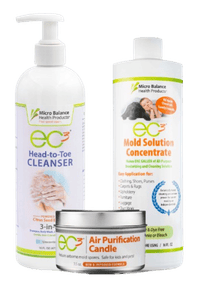
They also work really well for other allergens! Like dust and pollen.
Related Post: Can’t Get Out of Mold Yet? How to Reduce Mold Exposure when You Have Mast Cell Activation Syndrome
Chemical Sensitivity and MCAS CAN Get Better
We frequently see people improve as they heal.
The team member we mentioned earlier? A few years ago, she had a severe asthma attack from walking into a hotel that had just shampooed the carpets.
She used to have migraines from someone wearing cologne. One time she even almost fainted while driving her dog home from the groomer who had applied perfume to the dog. A lung full of gasoline fumes would cause her legs to give out.
As she worked on calming mast cells, supporting detoxification, and healing her limbic system things improved.
She still holds her breath in the laundry aisle at the grocery. But if she gets a whiff of scented products, she doesn’t feel like she’s going to faint anymore.
And she still only uses non toxic cleaning products in her home because she wants to keep those health gains.
You really need to consider all the possible underlying triggers if you have Mast Cell Activation Syndrome or Histamine Intolerance.
If you are looking for someone to help you do that, you can read more about our clinic.
It is fairly simple to use safe cleaning and household products. And an easy change to make to support your body. So, don’t risk your health!
What are some of your favorite non toxic cleaners for a healthier home?
Ideas For a More Mast Cell Friendly Home
- Safe Skincare
- AquaTru Water Filter Review
- My Air Doctor Air Purifier Review
- How to Reduce Mold Exposure and Toxins when You Have Mast Cell Activation Syndrome
References:
D’Attis S, Massari S, Mazzei F, Maio D, Vergallo I, Mauro S, Minelli M, Bozzetti M, P: Assessment of CYP2C9, CYP2C19, and CYP2D6 Polymorphisms in Allergic Patients with Chemical Sensitivity. Int Arch Allergy Immunol 2019. doi: 10.1159/000497322.
Environmental Working Group’s Guide to Healthy Cleaning. https://www.ewg.org/cleaners/
Meggs, William J. The Role of Neurogenic Inflammation in Chemical Sensitivity (2017) EcopsychologyVol. 9, No. 2 Published Online:1 Jun 2017 https://doi.org/10.1089/eco.2016.0045
Seema Patel. Fragrance compounds: The wolves in sheep’s clothings, Medical Hypotheses, Volume 102, 2017, Pages 106-111, ISSN 0306-9877, https://doi.org/10.1016/j.mehy.2017.03.025.
Afrin, L. B., et al. (2023). Chemical intolerance and mast cell activation: A suspicious synchronicity. International Journal of Environmental Research and Public Health, 20(21), 10928. https://pmc.ncbi.nlm.nih.gov/articles/PMC10660865/
Anderson, S. E., et al. (2021). Altered toxicological endpoints in humans from common quaternary ammonium compound disinfectant exposure. Toxicology Reports, 8, 646–656. https://doi.org/10.1016/j.toxrep.2021.03.006
Dodson, R. E., et al. (2012). Endocrine disruptors and asthma-associated chemicals in consumer products. Environmental Health Perspectives, 120(7), 935–943. https://doi.org/10.1289/ehp.1104052
Kim, H., et al. (2014). Chronic low dose chlorine exposure aggravates allergic inflammation and airway hyperresponsiveness and activates inflammasome pathway. PLOS ONE, 9(9), e106861. https://pmc.ncbi.nlm.nih.gov/articles/PMC4159271/
Kobayashi, S., et al. (2022). Identification of combinations of endocrine disrupting chemicals in household chemical products that require mixture toxicity testing. Chemosphere, 302, 134819. https://doi.org/10.1016/j.chemosphere.2022.134819
Merle, C., et al. (2022). Quaternary ammonium compounds in hypersensitivity reactions. Frontiers in Toxicology, 4, 973680. https://doi.org/10.3389/ftox.2022.973680
Steinemann, A., et al. (2013). Chemical emissions from residential dryer vents during use of fragranced laundry products. Air Quality, Atmosphere & Health, 6(1), 1–6. https://doi.org/10.1007/s11869-011-0156-1
Some links in this website are affiliate links, which means Mast Cell 360 may make a very small commission if you purchase through the link. It never costs you any more to purchase through the links, and we try to find the best deals we can. We only recommend products that we love and use personally or use in the Mast Cell 360 practice. Any commissions help support the newsletter, website, and ongoing research so Mast Cell 360 can continue to offer you free tips, recipes, and info. Thank you for your support!

I do want to offer fragrance and chemical free pre-cleaning options for guests with MCAS and similar sensitivities. Your article has given me the info I needed. Thanks!
Hi Alison! Glad to hear that the blog was helpful!
This is SO helpful! I have a question. Do you know if mast cells can accumulate on surfaces like sheets? Or are they 100% under the skin. I’m a chronic hive sufferer and was wondering if I should change my sheets more often. I have been leaving them a little longer to avoid detergent but then it didn’t seem to be helping so I thought “am I just making it worse?”
Hi Tory, I’m so sorry to hear you’re dealing with chronic hives. Mast Cells are in every part of the body except your retina. You may look at some other areas in your home that may be triggering the hives. If they are mostly occurring at night when in your bed, you may want to explore whether there is a trigger like chemicals or mold in your mattress as well. You might find this blog of interest: https://mastcell360.com/non-toxic-mattress/. Since we are unfamiliar with your case we cannot say what is causing your hives. Please note our resources are for informational and educational purposes only.
Have you looked into VitalOxide brand? I had someone recommend it to me from an online MCAS group. I didn’t compare ingredients but supposed to be hospital grade and doesn’t have a smell to me.
Hi Tiffany, VitalOxide is not a brand that we have experience with so are unable to comment on it at this time.
Steam cleaning is also a great alternative to all kinds of cleaning fluids and sanitizing fluids.
Hi Heidi! Thanks for sharing another option. When using steam cleaning we always recommend drying the equipment out completely to prevent mold growth.