
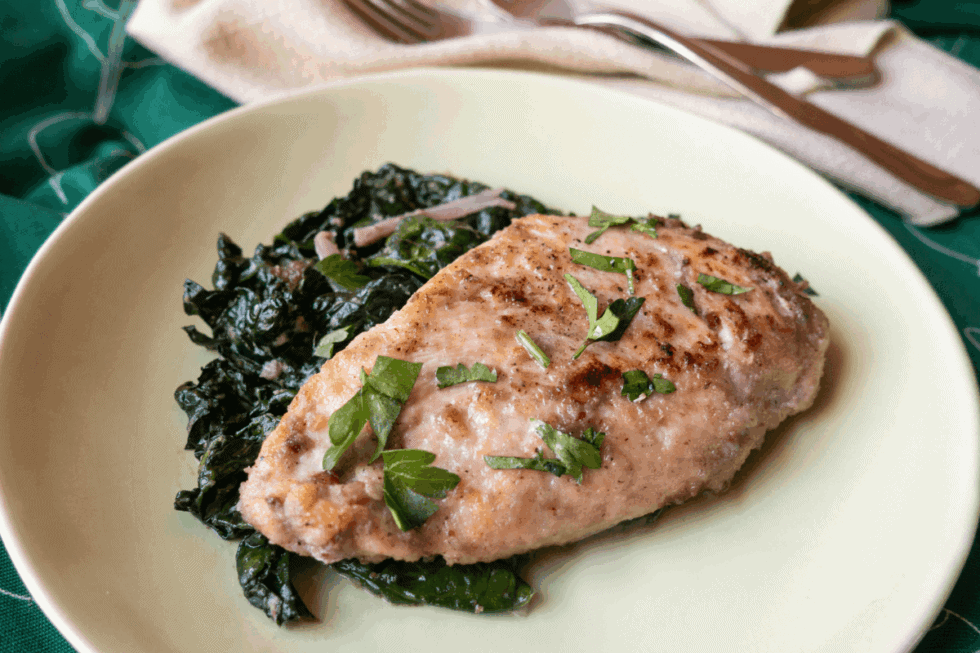
Low Histamine Chicken Florentine (also Low Oxalate and Low Lectin)
Chicken Florentine sounds fancy, but it’s simply an Italian dish of chicken served in a creamy spinach and garlic sauce.
Our low histamine recipe reimagines this classic recipe with fresh kale, coconut milk, shallots, and garlic.
It’s a tasty dish sure to delight your tastebuds!
And the best part is you only need one pan to make enough to serve up to 4 people.
This recipe is:
- Low histamine
- Low oxalate
- Low lectin
- Dairy free
- Gluten free
Read on to learn about the top components of this recipe and how we made a low histamine variation of this classic favorite.
You can use these tips to modify your favorite recipes, too!
Modifying Recipes
One of our top tips when starting the low histamine diet is to think about replacing foods rather than eliminating them.
Sometimes, you need to get creative when you do this with recipes!
That’s why from time to time, we share how we build our low histamine recipes. We hope it helps you modify your own favorites.
Here are the top components of chicken Florentine. You’ll learn how to replace the traditional high histamine ingredients to make this recipe low histamine.
Before you change your diet on your own, please make sure you’re working with a healthcare practitioner who can help you with this. Never limit foods unnecessarily, and always have a licensed medical provider who is supervising your case.
Low Histamine Chicken
Generally, we’ve seen chicken to be one of the best tolerated sources of animal protein when it comes to Histamine Intolerance.
But do you sometimes tolerate “fresh” (meaning never frozen) chicken and other times you don’t?
You aren’t alone! Histamine levels in chicken vary.
It can depend on how the chicken is processed, stored, shipped, and displayed.
With meats, histamine levels will be the lowest if meat is:
- Processed cleanly and efficiently
- Frozen as soon after slaughter as possible
- Frozen until ready for consumption
Why frozen over fresh? Bacterial growth.
Freezing hinders bacterial growth even more than refrigeration.
Did you know that by the time you buy unfrozen aka “fresh” chicken at the store, it could be up to a week old?
During this time, bacteria can build and raise histamine levels. This is especially true in environments where temperature isn’t strictly regulated.
That may account for some variation in tolerance in those who are super sensitive.
Freezing chicken immediately after slaughter and processing goes a long way to keeping histamine levels lower.
That’s why our favorite suppliers are Northstar Bison and White Oak Pastures.
Check out our favorite low histamine meat suppliers below! And save with our coupon codes.

>>> Use code MASTCELL360 for 10% off your first order at Northstar Bison

>>> Use code MASTCELL360 for 10% off your first order at White Oak Pastures
Another benefit of chicken from these companies? Their chickens are pasture-raised.
One study showed that meat from free-range chickens was higher in protein, iron, and zinc.
That study was done on free-range vs conventionally raised chickens.
Pasture raised chickens are even better than free-range.
Let your food work for you! Nutrients are important for your body as you heal!
Dredging, aka Coating
A light batter is used in our chicken Florentine.
Many batters call for all-purpose flour, a type of bleached flour with gluten. We avoid both of these on the low histamine diet.
In this recipe, we’ve used Otto’s Cassava Flour and ground pecans instead.
Cassava flour is low histamine. It’s made from the cassava plant root. You may know this better as yuca.
You can learn more about cassava flour in our low histamine cassava tortilla recipe post.
Pecans are also low histamine. We’ve used pecan butter for both the breading and in place of cheese.
You’ll read more about the cheese component in a minute.
But right now, here’s what to know about the “nut butter”.
In this recipe, pecan butter is really just finely ground pecans.
The natural oils in them will start to form a loose and dusty paste. But for the most part, it’s still more powdery than creamy.
That’s what you will aim for.
Since we’re talking about pecans, let’s look at how they work in the sauce next.
The Low Histamine Sauce
Here are the main components that typically make up the sauce in chicken Florentine.
In each section, we’ve indicated if these ingredients are ok for the low histamine diet.
If not, we’ve shared our low histamine replacements.
Let’s start with an important note about the sauce itself before getting to the ingredients.
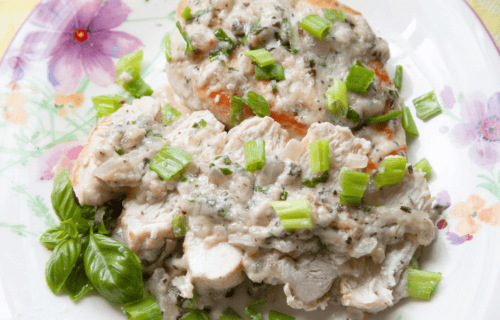
Most of the liquid sauce absorbs into the kale, so it doesn’t look saucy like a traditional Florentine.
That’s to say, you aren’t going to have a liquid that can be poured.
If your dish looks more like chicken with a side of kale, don’t worry. That’s what it’s supposed to look like.
We understand this isn’t like traditional Florentine. But like we said earlier, sometimes you have to get creative!
When adapting recipes, aim for inspiration not perfection.
You’ll probably stumble onto some really tasty flavor combos!
Cream or Coconut Milk
Chicken Florentine typically features a Mornay sauce.
The Mornay sauce starts with one of the mother sauces in French cuisine, béchamel.
Béchamel is a rich, white sauce made with butter, flour, and milk. From here, you add cheese to make the Mornay.
Instead of milk and cheese, we’ve used coconut milk and nut butter.
Using coconut milk changes the flavor slightly, giving it a mild sweetness.
But we think it’s balanced with garlic, shallots, and fresh herbs.
And nuts are an interesting choice to use instead of cheese when following the low histamine diet.
Some cheeses are actually lower histamine. For example, young cheeses like cream cheese or ricotta cheese.
But during phase 1 of the low histamine diet, it’s generally recommended to avoid dairy.
You sometimes hear cheese referred to as “nutty”. That inspired us to use nuts instead of a hard cheese like parmesan.
Cheese and nuts are both considered “umami”. That’s the savory fifth taste profile alongside salty, sweet, bitter, and sour.
Umami is the deep, rich flavor you get from fermented foods, mushrooms, meats, and other high protein foods. Like cheese and nuts.
We’re not suggesting that nut butter gives you the same textural component as cheese. It’s not a direct substitute.
But it does add flavor and creaminess.
Garlic and Shallots
Garlic and shallots are both ok on the low histamine diet.
Some chicken Florentine recipes call for just garlic. Others call for garlic and onions.
We went with garlic since it’s one of the traditional ingredients in chicken Florentine.
And we’ve used shallots.
Shallots have a milder, slightly sweeter flavor than onions.
We think this adds a more complex flavor profile than using garlic alone.
Spinach: Swap for Low Histamine Kale
Both spinach and kale are hearty greens that make up part of a nutritious diet.
But spinach is high histamine and kale is low histamine.
If you’re not a fan of kale, you could experiment with any leafy green that holds up to some heat.
Lettuces in general won’t be a good option. They wilt down becoming limp and stringy.
Collards could be an option, though.
They are a heartier green, like kale. And actually, a little less bitter. Depending on your taste, this may even be your preference!
Stick with lacinato kale (also called dinosaur kale) if you have Oxalate Intolerance. Curly kale is high oxalate.
Check out the low histamine food list to see what other greens appeal to you. And be sure to drop us a comment if you try something different!
And please let us know if the greens you used absorbed the sauce like kale or if you had liquid sauce left in the pan, too!
Low Histamine Wine or Low Histamine Apple Juice
Wine is often used for acidity and flavor.
The alcohol in wine helps break down fats enhancing a food’s natural flavor.
And as wine heats, the flavors of the wine itself become more concentrated, making your dish even tastier.
Acidity can also balance rich, creamy dishes.
Some recipes for chicken Florentine call for wine.
You may have already been successful in reintroducing higher histamine foods in moderation if you’re in phase 3 of the low histamine diet.
If you’ve done well, you might be interested in trying this recipe with wine.
But you’ll likely still be better off with a lower histamine wine like those from Dry Farm Wines.
Related Article: Lower Histamine Wine
If you aren’t in phase 3 yet, don’t worry. We’ve tested this recipe with apple juice for those who are still sensitive.
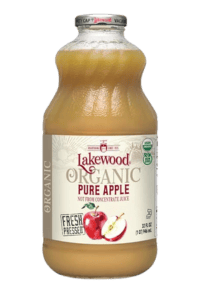
One option is store-bought organic apple juice with no additional ingredients.
Here’s one we like: Lakewood Organic Apple Juice
But making your own juice is even lower histamine for those who are super sensitive.
You can use a juicer if you have one.
If not, here’s a hack for making apple juice without a juicer:
- Rough chop an apple
- Add it to a blender with about 2 Tablespoons of filtered water.
- Add more water little by little until you get a thinner consistency.
It won’t be exactly like juice, but for cooking it’s fine.
We used green apples in this recipe to make our juice. The tartness is a closer simulation to the acidity you’d find in wine, vinegar, or citrus.
However, any apple will bring brightness and complexity to the dish.
What to Expect with Low Histamine Chicken Florentine
We touched on this earlier, but we want to make sure you know that the sauce will mostly be absorbed by the kale.
That means you won’t have a “sauce” as such that you pour over the chicken.
Simply serve the chicken atop the flavorfully infused kale.
We aren’t sure why, but when we’ve added coconut milk or coconut cream to kale, it absorbs it like a sponge!
That means every bite is super packed with flavor. You just don’t have a pourable sauce.
Related Recipe: Low Histamine Creamed Kale Recipe
One tip for this recipe. Use a meat mallet to even out the thickness of your chicken breasts to help with even cooking.
And remember, the pecan butter in this case is really just finely ground pecans.
The natural oils in them start to form a very loose and dusty paste.
But for the most part, your pecan butter will be more powdery than creamy.
That’s what to aim for.
Enjoy this low histamine take on chicken Florentine!
What to Serve with Low Histamine Chicken Florentine
- Asparagus with Garlic and Ginger Sauce – Low Histamine, Low Oxalate, Low Lectin
- Chinese Broccolini Recipe Inspired by Gai Lan Chinese Broccoli – Low Histamine, Low Oxalate, Low Lectin, Low FODMAP
- Low Histamine Roasted Cauliflower with Cherries and Pecans Recipe – Low to Medium Oxalate, Low Lectin, Low Salicylate Option
Low Histamine Chicken Florentine
Equipment
- Sharp Knife
Ingredients
- 2 Tablespoons Shallots diced (about 1 medium shallot)
- 1 Tablespoon Garlic minced
- 2 Tablespoons Fresh Organic Flat Leaf Parsley chopped
- 2 teaspoons Fresh Organic Thyme chopped
- ⅓ cup Organic Pecans finely ground, divided
- ½ teaspoon Redmond Real Salt divided
- ¼ teaspoon Freshly Ground Pink Peppercorns
- ¼ cup Otto's Cassava Flour
- 4 Tablespoons Kasandrino’s Olive Oil
- 4 Low Histamine Chicken Breasts (about 4 ounces each)
- 8 ounces Fresh Lacinato Kale woody stems removed, rough chopped
- 1 cup Organic Apple Juice
- 1 ½ cups Native Forest Coconut Milk
Instructions
- Prep all the produce: Peel and mince the shallots and garlic. Wash the kale and fresh herbs, then finely chop. Set aside.
- Finely grind the pecans until they start to form a paste, but it is still a bit powdery. Set aside.
- To the medium mixing bowl, add ¼ teaspoon salt, pepper, cassava flour and ¼ cup of the pecan “butter”. Dredge the chicken in the mixture until evenly coated. Set aside.
- Over medium heat, add 1 Tablespoon of olive oil to a large skillet. Add kale. Cook until starting to wilt, about 5 minutes. Transfer to a small bowl and set aside.
- Still over medium heat, add 2 Tablespoons of olive oil to the pan you cooked the kale in.
- Add the dredged chicken and cook until lightly browned, about 4 to 5 minutes per side or until the internal temp of your chicken is 165° F. Don’t overcook because it will cook a little bit longer in an upcoming step. For now, remove chicken from pan and set aside.
- Add the remaining 1 Tablespoon of olive oil to the now empty pan. Still on medium heat, add garlic, shallots, apple juice, coconut milk, remaining pecan butter, parsley, thyme, and remaining ¼ teaspoon salt. Stir about 1 minute until combined.
- Add the wilted kale and chicken and simmer until chicken is heated through, about 2 to 3 minutes.
- Serve chicken over top kale mixture. Garnish with parsley if desired.
Notes
Nutrition
This low histamine chicken Florentine recipe gives you a serving of vegetables and protein in one recipe. Would you like to see more “one pan” dinners?
More Low Histamine Chicken Recipes
- Chicken with Green Sauce – Low Oxalate, Low Lectin
- Asian Chicken Lettuce Wraps – Low Oxalate, Low Lectin, Low FODMAP
- Salad & Dressing with Baru Nut Crusted Chicken – Low Oxalate, Low Lectin, Low FODMAP
The website provides approximate nutrition information. Users should calculate the nutritional information with the actual ingredients and quantities they use in their recipes for the most accurate representation.
Some links in this website are affiliate links, which means Mast Cell 360 may make a very small commission if you purchase through the link. It never costs you any more to purchase through the links, and we try to find the best deals we can. We only recommend products that we love and use personally or use in the Mast Cell 360 practice. Any commissions help support the newsletter, website, and ongoing research so Mast Cell 360 can continue to offer you free tips, recipes, and info. Thank you for your support!
References
Dark Green Leafy Vegetables : USDA ARS. (n.d.). https://www.ars.usda.gov/plains-area/gfnd/gfhnrc/docs/news-articles/2013/dark-green-leafy-vegetables
HappyForks. (n.d.). Recipe analyzer. https://happyforks.com/analyzer
Larson, S. (2024, September 26). How to Cook with Wine: Tips for Elevating Your Dishes. Escoffier Online. https://www.escoffieronline.com/5-tips-for-cooking-with-wine/
Lin, C. Y., Kuo, H. Y., & Wan, T. C. (2014). Effect of free-range rearing on meat composition, physical properties and sensory evaluation in Taiwan game hens. Asian-Australasian journal of animal sciences, 27(6), 880–885. https://doi.org/10.5713/ajas.2013.13646
Add A Comment