
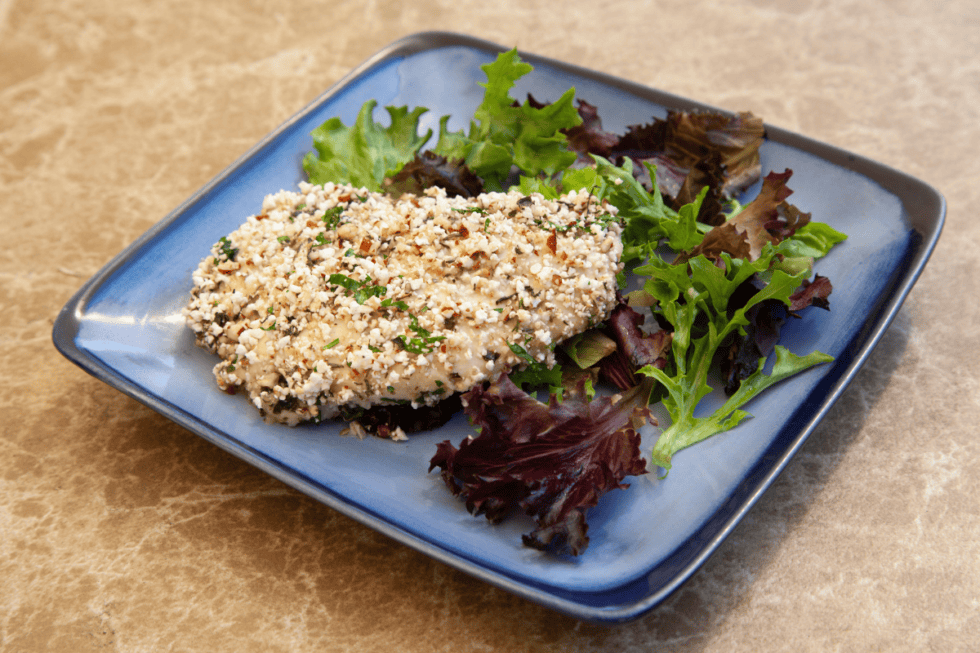
Is Chicken Low Histamine? Low Histamine Italian Baked Chicken Recipe (also Low Lectin, Medium Oxalate, Low FODMAP)
Is chicken low histamine? You’ll find it listed on our low histamine foods list.
Then why do some people have reactions to this low histamine protein?
Keep reading to find out more, including how cooking times and thawing methods can increase histamine levels in meat.
Plus, you’ll get the Italian Baked Chicken Recipe.
We’ve been experimenting with ways to make low histamine “breadcrumbs” without starting with homemade low histamine bread.
In this recipe, we made a lightly crusted chicken using popped sorghum and pecans for the topping.
And oregano, thyme, parsley, and FODMAP friendly garlic infused olive oil give this meal the flavors you’d find in tasty Italian dishes.
This recipe is:
- Low histamine
- Medium oxalate
- Low lectin
- Low FODMAP
- Dairy free
- Gluten free
Let’s jump right in!
Is Chicken Low Histamine?
Before you change your diet on your own, please make sure you’re working with a healthcare practitioner who can help you with this. Never limit foods unnecessarily, and always have a licensed medical provider who is supervising your case.
We put together a low histamine foods list to help you navigate the low histamine diet.
On it, we listed low histamine foods and high histamine foods. (We included histamine liberators with high histamine foods, too.)
Some foods have a naturally high histamine content.
Just a few examples of high histamine foods include:
- Aged beef
- Aged cheese
- Fermented foods (sauerkraut, kefir, kimchi)
- Eggplant
- Spinach
- Green Beans
Other foods cause the body to produce histamine even though they are considered low histamine foods. These are known as histamine liberators.
A few examples of histamine liberators include:
- Citrus Fruits
- Pineapple
- Walnuts
Some foods have naturally low histamine levels.
Certain meats and grains as well as many fresh fruits and fresh vegetables have lower levels of histamine.
Chicken is considered a low histamine food.
And it tends to be one of the animal proteins best tolerated by our clients.
That being said, we’ve still seen people with Histamine Intolerance or Mast Cell Activation Syndrome (MCAS) having reactions to chicken.
They may display common symptoms of Histamine Intolerance like:
- Gut Issues
- Headaches
- Hives
- Itchiness
- Rashes
Why do these reactions occur, even in a low histamine food?
The answer isn’t always the food itself.
The quality of the meat is the first step to consider. But it’s not the only one.
Here’s more.
Choosing Low Histamine Protein: Why Meat Quality Matters
You’ll come across all different kinds of labels when you shop for chicken.
These terms usually refer to how the chickens have been raised.
Chickens can be raised:
- Conventionally
- Organically
- Pastured
- Free Range
We suggest skipping conventionally raised chickens, and even free range.
Instead, opt for organic or pasture raised.
Conventionally Raised
Conventionally raised chickens may be given food treated with pesticides and herbicides.
And this residue has been detected in the meat in testing.
These toxins can be mast cell triggers.
The quantity found in tested meat has been said to be within tolerable limits for the average population.
But we’d prefer to have as few chemicals in our food as possible!
And while the general public may not see immediate effects of this, the sensitive population may.
Free Range Vs Pasture Raised
Free range sounds positive. But it’s not as good for the animals as being pasture raised.
Pasture raised chickens get more time outside. They can forage naturally, usually in addition to receiving feed.
Free range chickens do get outdoor time. However, it isn’t usually as much as pastured.
And they often only subsist on commercial feed of varying ingredients, rather than being able to forage, too.
We’ll get to why the type of feed matters in the next section: Better Taste, Better Nutrition.
But first, here’s more on organic and pasture raised and what that means.
Organic Vs Pastured
Organic certification is complicated.
That’s why some companies practice raising their products organically, but don’t have technical certification.
So, in some instances, organic or pasture raised can both be good choices.
Among other things, organic chickens must:
- Eat feed produced without synthetic pesticides, herbicides, fertilizers
- Not be given antibiotics or hormones
- Must have access to outdoors to roam freely
Did you know that in the US, growth hormones in poultry have been banned since the 1950s? The same is not true for beef cattle, though!
Now, as we said, organic certification can be complicated.
But some suppliers have excellent standards for raising and harvesting poultry without technically being organic.
For example, Northstar Bison offers pasture raised chickens.
Northstar’s chickens are:
- Pasture raised
- Organically raised
- Humanely harvested
- Hormone free
- Antibiotic free
- Soy free
- Corn free
- Glyphosate free (Big mast cell trigger!)
Related Article: What to Know About Corn if You Have Mast Cell Activation Syndrome or Histamine Intolerance
A lot of big plusses there!
And did you know that better animal welfare results in improved taste and quality of organic/ pastured chickens versus conventionally raised chickens?
Here’s more on that.
Better Taste, Better Nutrition
It’s been shown that corticosterone levels in conventionally raised chickens are higher. (This is like the stress hormone, cortisol, in humans.) This can result in tougher meat.
High stress hormones is another strike against conventionally raised chickens, in addition to the pesticide residue.
Further, organic or pasture raised chickens offer better nutrient content.
One study we read showed that pastured hens who are also given quality feed mix produced eggs with more vitamin E and omega-3 fatty acids versus eggs from caged hens fed only commercial feed.
And when it comes to meat, pasture-raised poultry tends to be higher in:
- Iron
- Omega 3s
- Antioxidants like Vitamin E
And it has a lower Omega 6:3 ratio.
Conventionally raised animals have a limited diet. And this limited diet can yield higher inflammatory fats like omega 6s
As a consumer of this meat, this high intake of omega-6 fatty acids can lead to increased levels of arachidonic acid for you!
Studies on mast cells have shown that the metabolism of arachidonic acid can generate free radicals that trigger histamine release and increase inflammation.
On the other hand, animals allowed to forage on natural bugs as well as grasses and hay have higher Omega 3s, the anti-inflammatory fats.
And omega 3s support mast cells. Great news for those with Mast Cell Activation Syndrome (MCAS).
But what does this mean for taste?
Many consumers have reported that the taste of organic or pasture raised chickens is richer in flavor.
We agree!
Tried organic or pastured chicken and are still having reactions?
Here’s what to consider next.
Are You Reacting to “Low Histamine” Chicken?
Some people react even to fresh, organic chicken from the grocery store.
And for some people, these reactions aren’t consistent.
Even the same product from the same source can have mixed results.
Here’s why that may be happening.
Time and temperature are 2 key factors that play a role in histamine growth in meat.
Time and Temperature
Both time and temperature contribute to bacterial growth. Certain bacteria release histamine.
Even the best quality meat will be affected by these factors.
If you’ve been reading the blog for a while, you may be familiar with why.
We’ve talked about it in more detail in The Best Low Histamine Meat and Seafood article, as well as several recipe posts.
But if you’re new, here’s the basic brief.
Getting fresh meat from the store may not be as fresh as you think.
Even if the chicken is refrigerated during transportation, it’s going to increase in histamine-releasing bacteria faster than if it were frozen.
Then there’s the time it sits in the store before you buy it.
As any perishable ages, it is prone to higher bacteria growth, and thus higher histamine.
Further, if you’re getting “fresh chicken” out of a deli case, here’s what to know.
Temperatures in a deli case fluctuate more than in a refrigerator.
Temps can vary due to overcrowding and frequent door openings.
That’s why getting chicken that’s frozen asap after being processed can be very helpful, especially for those who are very sensitive.
Freezing lessens bacteria growth and thus slows the release of histamine that would come from those bacteria.
Quick Review
- Start with quality chicken, either organic or pasture raised
- Choose frozen over “fresh” to minimize bacterial growth (lower histamine)
This is another reason we love companies like Northstar Bison for our favorite suppliers of low histamine meats.
They freeze the meat right away. This doesn’t affect taste or texture at all!
And many of their products are IQF (individually quick frozen). This means they won’t all stick together. You can thaw and use only what you need.

>>> SAVE 10% with code MASTCELL360 on Northstar Bison Meats
Now you’ve got these factors covered by choosing quality and frozen. Why might you still be reacting?
Thawing Practices and Cooking Times
Thawing times play into the temperature and time factors you just read about, too!
Have you been thawing your poultry on the kitchen counter for hours?
It’s not the best way to thaw, in general. But it’s even worse for those with Histamine Intolerance.
Fully thawing meat and seafood in the fridge for hours may be ok for those less sensitive.
For most of our audience, however, we typically suggest thawing in the fridge until just frosty if you are going to use this method.
But if you’ve been doing this and having reactions, there’s still an even better way to thaw.
Water Bath Method
This is our preferred method for thawing.
Here’s what to know about the water bath method:
- Works well for smaller cuts of meat
- Should only be used for sealed meat (in a package; don’t put raw, exposed meat into a water bath.)
This is how we will typically thaw using a water bath.
Start with a bowl of tepid water. You can use cool water, but it will take longer. Don’t use hot water.
Choose a bowl big enough that the meat can be completely submerged. You may need to weigh the meat down by placing a heavy object on top.
Keep meat submerged for about 15 to 20 minutes total.
TIP: Replace your water after ten minutes to help speed up the process. Frozen food lowers the temperature of the water making thaw time longer.
You can learn more about this and the pros and cons of all thawing methods in The Mast Cell 360 Guide to Our Favorite Kitchen Staples and Top Low Histamine Food Tips.
PS You can also cook some foods from a frozen state!
Next, let’s look at how cooking methods and times may also contribute to higher histamine levels.
High Histamine Cooking Methods
Studies have shown that grilling and frying at high temperatures can cause an increase in histamine levels in foods prepared by those methods.
It’s been suggested that a possible reason for this relates to moisture content.
Moisture lost by evaporation during grilling or frying could cause the histamine concentration to increase.
On the other hand, histamine levels in some foods decreased when boiled. This may mean that as the food absorbs water, the histamine concentration is diluted.
But let’s face it, boiled meat isn’t the tastiest.
But do keep this in mind if you need to try it! It’s always better to get a variety of foods in in ways you tolerate.
So, somewhere in between, we look at other methods like baking.
But when it comes to cooking, time also matters.
Some bacteria that cause food to spoil become inactive during the cooking process. However, histamine that’s already present is heat resistant.
And slow cooking doesn’t kill or inactivate bacteria right away. Meaning that histamine–releasing bacteria can continue to grow during a low and slow cook.
Generally speaking, we try to keep our meat cook times to under 45 minutes or less, if possible.
This means no long roasting times.
This recipe takes about 30 minutes. It’s an easy weekday dinner.
TIP: One way we’ve been able to get low histamine roast chicken and pork is in the Instant Pot.
Still having reactions?
If you are still very sensitive due to food intolerance like Histamine Intolerance, you may need a little extra help at the beginning of your journey.
Supporting Your Health with Histamine Intolerance and Mast Cell Activation Syndrome (MCAS)
Supplements like diamine oxidase (DAO) can also be helpful for those who need an “antihistamine.”
DAO is a histamine degrading enzyme that your body makes. People with Histamine Intolerance can have low levels of DAO.
That’s where supplementation can help.
And if you’re only tolerating a handful of foods in general, here are some other things to consider:
- Keep a food diary and consult with a registered dietitian. Elimination diets can be helpful for some, but it’s important to work with a professional healthcare provider to make sure you’re getting enough nutrition and not eliminating foods unnecessarily.
- Consider if your immune system may be dysregulated due to other reasons such as Mold Toxicity, the number 1 root cause of MCAS we see.
- Consider working to support your nervous system to help calm mast cells and reactions.
If you are able to eat chicken now, here are our top tips for this recipe.
And if you aren’t quite there yet, hang in there!
Keep up the good work! You are worth it!
Top Tips for Making Low Histamine Italian Baked Chicken and What to Expect
We mentioned that we’ve been experimenting with making “breadcrumbs” without using bread.
We’ve used cassava flour and ground nuts in the past as a dredge. And that’s one option.
But when we made our snack mix recipe recently, we started wondering….
Could this popped sorghum work in place of breadcrumbs?
We used Nature Nate’s Popped Sorghum and combined it with ground pecans.
Here’s what to expect.
This isn’t a battered and deep-fried dish like what you might get from a fast-food restaurant.
And the coating isn’t as thick as you might expect from chicken parmesan.
Think of it more as a lightly crusted chicken breast.
And the popped sorghum is white and doesn’t change color when baked.
One taster noted that he liked the lightness of the herb, nut, and sorghum mixture, especially on a hot summer day. It didn’t feel too heavy.
Another taster noted that he liked the herbs being mixed in with the dredge to make each bite flavorful.
This herb infused coating is a nod to the comfort food feeling of breaded foods that we don’t get much of on the low histamine diet.
This recipe is super easy to make.
Here are a few tips to make it even easier.
- Pulse the pecans and the sorghum separately. You want a little texture in the pecans. You don’t want them turning into butter. Pulsing separately gives you the most control.
(PS if you do over pulse your pecans, don’t worry. You can use it as-is for flavor. You’ll just have less crunch.) - Use a meat mallet or other heavy implement to even out the thickness of the chicken breasts for a more even cook. You don’t need to pound them flat. The goal is only to thin out thicker sections.
- Really press the crumbs into the chicken to make sure it sticks as much as possible.
What to Serve with Low Histamine Italian Baked Chicken
- Creamed Kale – Low Histamine, Low Oxalate, Low Lectin
- Rutabaga Fries – Low Histamine, Low Oxalate, Low Lectin, Low FODMAP, Low Salicylate
- Low Histamine Coleslaw – Low Lectin, Low Oxalate, Low FODMAP Option, with Low Salicylate option
Low Histamine Italian Baked Chicken
Equipment
- 9 x 13 Glass Baking Dish
- Sharp Knife
- 2 Medium Mixing Bowls for dredging
- Meat Mallet optional
Ingredients
- 4 Low Histamine Chicken Breasts
- 1 ½ teaspoon Redmond Real Salt
- ¼ cup Garlic Infused Olive Oil
- 1 Tablespoon Kasandrino’s Olive Oil for greasing the baking dish, garlic or plain
- 1 cup Nature Nate's Popped Sorghum
- ¼ cup Organic Pecans
- 3 Tablespoons Fresh Organic Oregano
- 3 Tablespoons Fresh Organic Flat Leaf Parsley
- 2 Tablespoons Fresh Organic Thyme
Instructions
- Preheat oven to 350°F.
- Grease a large rectangular baking dish with olive oil (or fat of your choice) to prevent sticking.
- Use a meat mallet to even out the thickness of the chicken breasts if needed.
- Salt chicken breasts on both sides (about 1 teaspoon total for all breasts). Set aside.
- Pulse the pecans in a food processor. Remove and set aside.
- Pulse the popped sorghum in a food processor. (Do not pulse the pecans and sorghum together.)
- In a shallow dish, mix together the sorghum crumbs, pecans, oregano, parsley, thyme, and remaining ½ teaspoon of salt.
- In a separate shallow dish, add the garlic infused olive oil.
- Dip each chicken breast in the oil then dip each olive oil coated breast in the crumb and herb mixture. Coat both sides, firmly packing the chicken into the crumb mixture.
- Place the breaded chicken breasts in the baking dish.
- Top the chicken breasts with any remaining sorghum and herb mixture.
- Bake about 25-30 minutes (internal temperature 165° F).
Notes
Nutrition
With good quality chicken and low histamine prepping, the answer to, “is chicken low histamine?”, is yes! Did you enjoy this recipe? Let us know in the comments! We’re considering working with this even more for a chicken nuggets with dipping sauce recipe!
More Low Histamine Chicken Recipes
- Chicken Marinade Skewers – Medium Oxalate, Low Lectin, Low FODMAP
- Chicken with Green Sauce – Low Oxalate, Low Lectin
- Asian Chicken Lettuce Wraps – Low Oxalate, Low Lectin, Low FODMAP
The website provides approximate nutrition information. Users should calculate the nutritional information with the actual ingredients and quantities they use in their recipes for the most accurate representation.
Some links in this website are affiliate links, which means Mast Cell 360 may make a very small commission if you purchase through the link. It never costs you any more to purchase through the links, and we try to find the best deals we can. We only recommend products that we love and use personally or use in the Mast Cell 360 practice. Any commissions help support the newsletter, website, and ongoing research so Mast Cell 360 can continue to offer you free tips, recipes, and info. Thank you for your support!
References
Brenes, A. L. M., et al. (2020). Temperature profiling of open- and closed-doored produce cases in retail grocery stores. Food Control, 113, 107158. https://doi.org/10.1016/j.foodcont.2020.107158
Chung, B. Y., et al. (2017). Effect of different cooking methods on histamine levels in selected foods. Annals of Dermatology, 29(6), 706. https://doi.org/10.5021/ad.2017.29.6.706
Gao, J., Lin, H., Song, Z., & Jiao, H. (2008). Corticosterone alters meat quality by changing pre-and postslaughter muscle metabolism. Poultry Science, 87(8), 1609–1617. https://doi.org/10.3382/ps.2007-00007
Gueck, T., Seidel, A., & Fuhrmann, H. (2003). Effects of essential fatty acids on mediators of mast cells in culture. Prostaglandins Leukotrienes and Essential Fatty Acids, 68(5), 317–322. https://doi.org/10.1016/s0952-3278(03)00022-x
Gutiérrez, S., Svahn, S. L., & Johansson, M. E. (2019). Effects of omega-3 fatty acids on immune cells. International Journal of Molecular Sciences, 20(20), 5028. https://doi.org/10.3390/ijms20205028
HappyForks. (n.d.). Recipe analyzer. https://happyforks.com/analyzer
Jia, Q., et al. (2023). Pesticide residues in animal-derived food: Current state and perspectives. Food Chemistry, 438, 137974. https://doi.org/10.1016/j.foodchem.2023.137974
Karsten, H., Patterson, P., Stout, R., & Crews, G. (2010). Vitamins A, E and fatty acid composition of the eggs of caged hens and pastured hens. Renewable Agriculture and Food Systems, 25(1), 45–54. https://doi.org/10.1017/s1742170509990214
Kwon, B. Y., et al. (2024). Research Note: Welfare and stress responses of broiler chickens raised in conventional and animal welfare-certified broiler farms. Poultry science, 103(3), 103402. https://doi.org/10.1016/j.psj.2023.103402
Masini, E., et al. (1987). Mast cell histamine release induced by intermediate products of arachidonic acid metabolism. International archives of allergy and applied immunology, 82(3-4), 279–282. https://doi.org/10.1159/000234207
Osaili, T. M., et al. (2022). Detection and risk associated with organochlorine, organophosphorus, pyrethroid and carbamate pesticide residues in chicken muscle and organ meats in Jordan. Food Control, 144, 109355. https://doi.org/10.1016/j.foodcont.2022.109355
Theoharides, T. C., Tsilioni, I., & Ren, H. (2019). Recent advances in our understanding of mast cell activation – or should it be mast cell mediator disorders?. Expert Review of Clinical Immunology, 15(6), 639–656. https://doi.org/10.1080/1744666X.2019.1596800


Add A Comment