
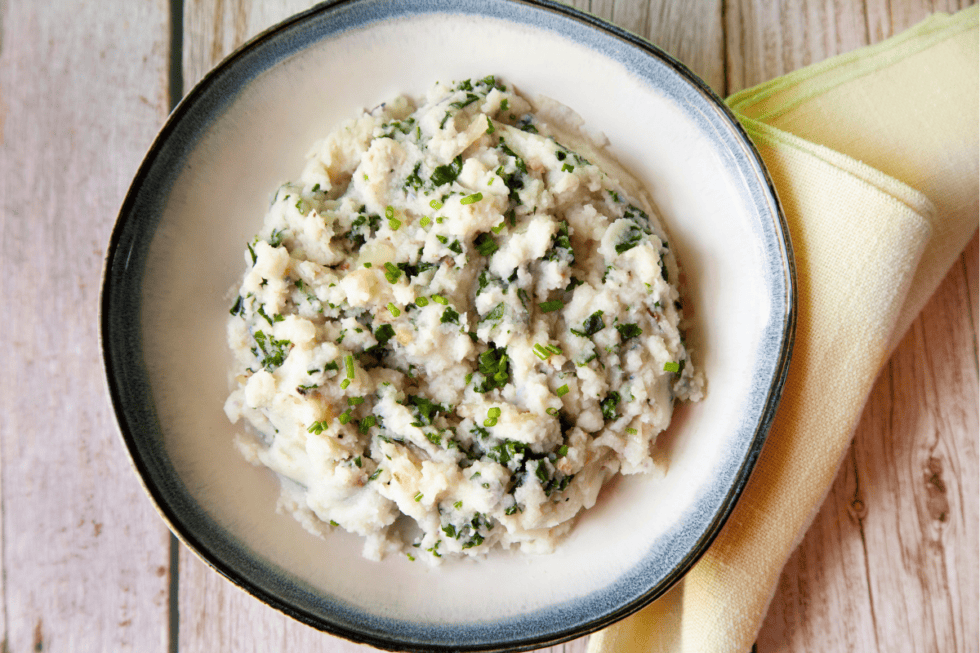
Low Histamine Cauliflower Mash with Kale: Colcannon Inspired (also Low Oxalate, Low Lectin)
This low histamine cauliflower mash with kale was inspired by a traditional Irish dish called colcannon.
Are you following a low histamine diet AND looking for low oxalate and low lectin recipes, too? If so, this take on mashed potatoes might be just the thing.
Colcannon is typically mashed potatoes mixed with a leafy green like cabbage or kale.
It also uses ingredients like milk, butter, and onions (or leeks).
In general, most colcannon recipes are low histamine.
However, potatoes aren’t low lectin or low oxalate. And you might be holding off on dairy if you are in Phase 1 of the low histamine diet and haven’t done the Dairy Zoomer yet.
This tasty and healthy side dish is great at any time of year. But it’s especially nice on cool nights when you want to warm up with comfort food.
This recipe is:
- Low histamine
- Low oxalate
- Low lectin
- Low salicylate (option)
- Dairy free
- Gluten free
- Vegetarian
Keep reading to learn the benefits of cauliflower and kale and to get our top tips for making this recipe!
Low Histamine Cauliflower Mash with Kale
Before you change your diet on your own, please make sure you’re working with a healthcare practitioner who can help you with this. Never limit foods unnecessarily, and always have a licensed medical provider who is supervising your case.
You might have heard of cauliflower mash or mashed cauliflower.
Its lower carbohydrate content made it popular with the keto diet or generally with anyone watching their carb intake.
Additionally, cauliflower is a great source of vitamins and other nutrients that support your body.
Next, let’s get a quick overview of the benefits of the two main ingredients in this dish, cauliflower and kale.
Cauliflower
Cauliflower is a powerhouse of vitamin C.
Just one cup of cauliflower has about 75% of the daily recommended value of vitamin C. For comparison, that’s almost as much vitamin C as one medium orange has.
Oranges are known to be a rich source of vitamin c, but citrus can be a histamine liberator. So, consider adding cauliflower to your meal plans to get a boost of vitamin C.
Vitamin C has benefits including:
- Needed for production of:
- Collagen
- Amino acids used in energy production
- Some neurotransmitters
- Plays a role in protein metabolism
- Plays a role in wound healing
- Has antioxidant properties
- Aids in immune function
- Improves the absorption of nonheme iron
You may be surprised that cauliflower is also a good plant-based source of vitamin B6.
Many people think of meat when they think of ways to get B6 from their food. And it’s true that meat contains a good amount of B6!
But plant-based foods can provide some B6, too.
Regardless of how you get your B6, be sure you are getting enough.
Some people have low diamine oxidase (DAO) levels because of nutritional deficiencies, including B6 deficiency.
DAO is one of the histamine degrading enzymes your body produces. Very important, especially if you have Histamine Intolerance.
One cup of cauliflower has .184 mg of B6. That doesn’t look like much!
However, the average recommended daily intake for B6 in women 51+ is about 1.5 mg.
That means that 1 cup of cauliflower is about 12% of your daily need. (RDA for women 19 to 50 is about 1.3 mg.)
Check out our other low histamine cauliflower recipes like:
Kale
Colcannon typically uses either cabbage or kale.
Although, when we asked around, a friend who’s been to Ireland frequently has even had colcannon without either!
We looked at numerous recipes in cookbooks and online, too. Some have kale, some have cabbage, and some mention that you can add cabbage or kale but don’t give instructions for incorporating them.
Very interesting indeed!
We chose to use kale because it added both nutrients and interest to the dish. We chose kale over cabbage because it took less time to cook. (We tried it both ways. We’ll tell you more in the Top Tips section.)
Admittedly, we chose kale because it was easier. Who doesn’t love an easy side dish? But kale has a lot to offer besides being easy to cook.
Kale is often referred to as a super food. These are nutrient dense foods, typically vibrant in color.
Kale is rich in vitamins like:
All of these are important for the health of your body, especially if you are dealing with Histamine Intolerance or Mast Cell Activation Syndrome (MCAS).
You already read just a few ways vitamin C and B6 can be beneficial.
When it comes to Histamine Intolerance or MCAS, here’s a quick look at how these other vitamins can support you.
Studies have shown that adequate iron can aid in decreased mast cell degranulation.
Iron is also important for processes including:
- DNA synthesis (essential for proper functioning of cells)
- Hormone balance
- Oxygen transport
- Immune Function
Magnesium has been shown to be helpful with:
- Stabilizing mast cells
- Reducing inflammation
- Can boost DAO activity
Related Post: The Best Magnesium for Histamine Intolerance and Mast Cell Activation Syndrome.
This recipe provides a good boost of important nutrients to your body. It tastes good, too!
Top Tips for Low Histamine Cauliflower Mash with Kale
Cauliflower mash may have taken off in popularity due to being low carb.
Another benefit is that cauliflower mash is easier to make than mashed potatoes.
Think of the time and energy you save by not having to peel potatoes!
Another way we simplified was using kale instead of cabbage. Truth told, we tried it both ways.
You can use cabbage in this recipe. It’s low histamine, low oxalate, low lectin, low FODMAP and low salicylate!
We chose to provide you with the kale recipe, though. That’s because one taster preferred the kale version because of the taste, and another preferred the kale because of the texture. Everyone is different!
We liked it both ways, but as we said, we went with kale for the official recipe card because it was easier.
If you want to use cabbage, here’s what to know.
Using Cabbage Option (Low Salicylate Modifications)
If you use cabbage, use your food processor to shred it.
You’ll get consistent and thin pieces which help it cook to a tender state quicker than thickly cut pieces.
Still, cabbage took longer to cook than kale. So, do plan a little extra time if you go this route. You’ll want the cabbage VERY tender.
You can make this recipe low salicylate if you:
- Replace 2 Tablespoons of Olive Oil with 2 Tablespoons Ghee
- Replace ½ cup + 2 Tablespoons Coconut Cream with ½ cup + 2 Tablespoons of Grass Fed Cream or Whole Milk
- Replace 2 cups Kale with 2 cups of Cabbage
Related Post: Salicylates and Salicylate Foods
Plain Cauliflower Mash
If you want things simpler still, both in taste and preparation, you can make this cauliflower mash plain, meaning you can omit the kale.
We would recommend keeping the onions and chives, though. Those elements added flavor that we think you’d miss if they are removed.
Preparing the Cauliflower
In our preparation, we steamed the cauliflower.
You can boil the cauliflower if you don’t have a steamer basket.
But the advantage of steaming is that veggies hold more of their nutrients. Water-soluble vitamins can leach into the boiling water that you discard.
If you choose to steam the cauliflower, be sure to keep the water below the steamer basket. We filled the bottom of the pot until it was just shy of seeping through the holes in the basket.
There will be water loss, but ours didn’t even come close to running dry. This is a concern to be aware of if you are steaming anything.
Just keep an eye on yours. Every pot, stove, and basket are different!
What to Serve with Low Histamine Cauliflower Mash with Kale
- Low Histamine Chicken Recipe – Low Oxalate, Low Lectin, Low Salicylate, Low FODMAP
- Turkey Breast with Cherries and Cranberries Sauce – Low Histamine, Low Oxalate, Low Lectin
- Low Histamine Pan Seared Filet Mignon Recipe – Low Oxalate, Low Lectin, Low FODMAP Option
Low Histamine Cauliflower Mash with Kale
Equipment
- Sharp Knife
- Large Pot with Lid
Ingredients
- 1 Medium Cauliflower Head 2 pounds, chopped (about 8 cups)
- 2 Tablespoons Kasandrino’s Olive Oil
- 1 Tablespoon Fresh Garlic Cloves minced
- ½ cup Let's Do Organic Coconut Cream plus 2 Tablespoons, divided
- ½ cup Yellow Onion diced
- 1 teaspoon Redmond Real Salt divided
- 2 cups Organic Kale tightly packed and finely chopped
- 1 teaspoon Fresh Organic Chives
* See notes for low salicylate option swaps
Instructions
- Start by steaming the cauliflower. Add enough water to a large pot so that it comes ever so slightly below the holes in the steamer basket. Bring water to a boil. Add your cauliflower and cover. Steam about 20 minutes or until tender. (There will still be some tooth to it, but it should be fork tender.)
- Meanwhile, in a small skillet over medium heat, add the olive oil, garlic, and salt and sauté until fragrant, about 1 minute.
- Add the kale to the garlic and sauté until tender. About 2 minutes. Transfer to a bowl and set aside.
- In the same skillet, add ½ cup of coconut cream, ½ teaspoon salt, and the onion. Cook over medium heat until onions are tender (about 6 minutes). Remove from heat and set aside.
- When the cauliflower is tender, thoroughly drain the water and transfer the cauliflower to a food processor along with 2 Tablespoons of coconut cream and remaining ½ teaspoon of salt. Pulse slowly to avoid over-processing. You want a mashed potato-like consistency, not runny. There will be some texture to the cauliflower, it won’t be totally smooth like mashed potatoes.
- Transfer the mashed cauliflower to a large bowl and stir in the garlic kale mixture as well as the onion mixture. Stir to combine.
- Top with chives.
Notes
- Replace 2 Tablespoons of Olive Oil with 2 Tablespoons Ghee
- Replace ½ cup + 2 Tablespoons Coconut Cream with ½ cup + 2 Tablespoons of Grass Fed Cream or Whole Milk
- Replace 2 cups Kale with 2 cups of Cabbage
Nutrition
Do you want to see more side dishes like this recipe for Low Histamine Cauliflower Mash with Kale? Let us know what sides you’d like to see us make low histamine!
More Low Histamine Vegetarian Sides
- Brussels Sprouts Shaved Salad with Garlic, Pecan, and Apple Dressing – Low Oxalate, Low Lectin, Low Salicylate option
- Broccoli Side Salad Recipe – Low Oxalate, Low Lectin
- Asparagus with Garlic and Ginger Sauce – Low Oxalate, Low Lectin
The website provides approximate nutrition information. Users should calculate the nutritional information with the actual ingredients and quantities they use in their recipes for the most accurate representation.
Some links in this website are affiliate links, which means Mast Cell 360 may make a very small commission if you purchase through the link. It never costs you any more to purchase through the links, and we try to find the best deals we can. We only recommend products that we love and use personally or use in the Mast Cell 360 practice. Any commissions help support the newsletter, website, and ongoing research so Mast Cell 360 can continue to offer you free tips, recipes, and info. Thank you for your support!
References
Abbaspour, N., Hurrell, R., & Kelishadi, R. (2014). Review on iron and its importance for human health. Journal of Research in Medical Sciences: The Official Journal of Isfahan University of Medical Sciences, 19(2), 164–174.
FoodData Central. (n.d.). https://fdc.nal.usda.gov/fdc-app.html#/food-details/169986/nutrients
FoodData Central. (n.d.). https://fdc.nal.usda.gov/fdc-app.html#/food-details/168421/nutrients
Garofalo, V., et al. (2023). Relationship between iron deficiency and thyroid function: A systematic review and meta-analysis. Nutrients, 15(22), 4790. https://doi.org/10.3390/nu15224790
HappyForks. (n.d.). Recipe analyzer. https://happyforks.com/analyzer
Nishio, A., Ishiguro, S., & Miyao, N. (1987). Specific change of histamine metabolism in acute magnesium-deficient young rats. Drug-nutrient interactions, 5(2), 89–96.
Office of Dietary Supplements – Vitamin B6. (n.d.). https://ods.od.nih.gov/factsheets/VitaminB6-Consumer/
Office of Dietary Supplements – Vitamin C. (n.d.). https://ods.od.nih.gov/factsheets/VitaminC-HealthProfessional/
Roth-Walter, F. (2021). Compensating functional iron deficiency in patients with allergies with targeted micronutrition. Allergo Journal International, 30(4), 130–134. https://doi.org/10.1007/s40629-021-00171-9
Seidl, H., Kellner, K., & Maier, D. (2024). B-071 Unraveling histamine intolerance: Exploring DAO quantity, elimination ratios and cofactor influences. Clinical Chemistry, 70(Supplement_1). https://doi.org/10.1093/clinchem/hvae106.433
Srebro, D., et al. (2023). The interactions of magnesium sulfate and cromoglycate in a rat model of orofacial pain; The role of magnesium on mast cell degranulation in neuroinflammation. International Journal of Molecular Sciences, 24(7), 6241. https://doi.org/10.3390/ijms24076241
Teh, M. R., Armitage, A. E., & Drakesmith, H. (2024). Why cells need iron: a compendium of iron utilisation. Trends in Endocrinology and Metabolism. https://doi.org/10.1016/j.tem.2024.04.015
Veronese, N., et al. (2022). Effect of magnesium supplementation on inflammatory parameters: A meta-analysis of randomized controlled trials. Nutrients, 14(3), 679. https://doi.org/10.3390/nu14030679
Add A Comment