
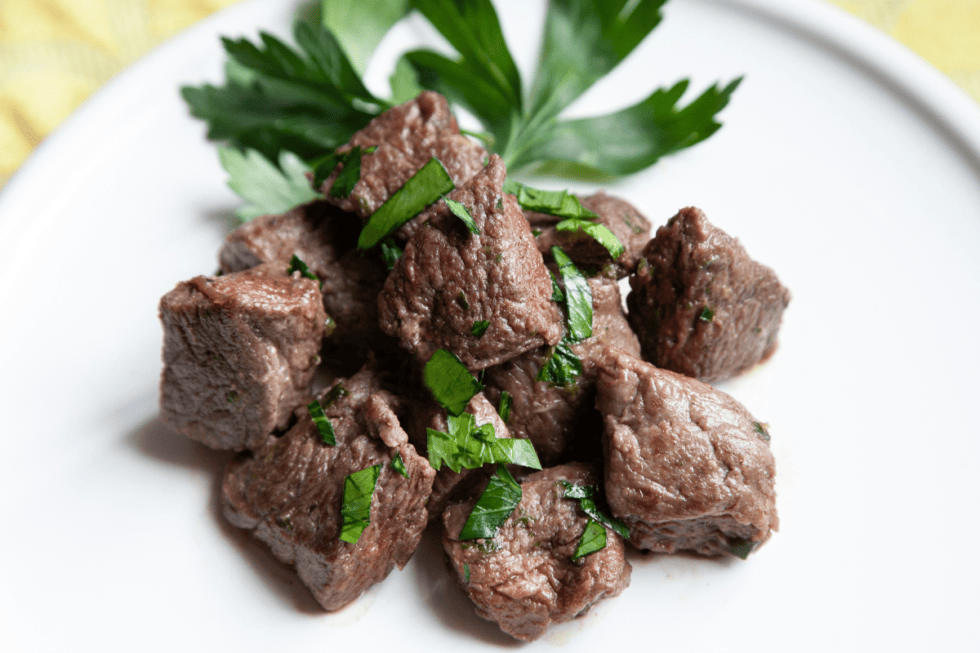
Is Bison Low Histamine? Low Histamine Garlic and Ghee Bison Bites
Is bison low histamine?
The answer depends on a few factors we’ll cover in this post.
But the good news is that it can be part of your low histamine diet.
It’s delicious and packed full of nutrients!
In this post you’ll learn about:
- Sourcing low histamine bison
- Benefits of adding bison to your diet
- Tips for cooking bison
You’ll also get our recipe for low histamine garlic and ghee bison bites. A high protein meal you can have ready in minutes!
Garlic and ghee bison bites are:
- Low histamine
- Low oxalate
- Low lectin
- Low salicylate
- Gluten free
Let’s start by taking a look at what makes the difference between low and high histamine bison. And where you can get it!
Before you change your diet on your own, please make sure you’re working with a healthcare practitioner who can help you with this. Never limit foods unnecessarily, and always have a licensed medical provider who is supervising your case.
Is Bison Low Histamine?
Histamine levels vary even within the same kind of meat.
And for some people, food sensitivities can be related to mast cell reactions, too.
Related Post: What Are Mast Cells? Mast Cell Activation Syndrome 101
Reactions may be related to:
- How the animal was raised
- Freshness
- Processing methods
- Storage conditions
Related Post: Low Histamine Meat Tips and Common Mistakes
In the meat tips post above, you’ll also learn about fresh meat vs frozen meat. You may be surprised to learn that frozen meat may be better for those with Histamine Intolerance!
So, you’ll want to look for a source that freezes their meat soon after slaughter.
Let’s look at a few other things that affect histamine levels in meat and where to find low histamine bison next.
Low Histamine Bison: What to Look for and Where to Get It
You just read that buying frozen meat can help keep histamine levels lower.
And with bison, one of the top factors in differing histamine levels comes from aged vs unaged meat.
Bison steaks, like beef steaks, can be aged in controlled environments. It’s a common practice for many red meats like beef and bison.
Different suppliers use different techniques like dry aged or wet aged or a combination.
Aging times also differ, with some beef steaks being aged 60 days on the higher end and some bison steaks around 28 days on the higher end.
Some consumers say aging adds nuanced flavor to the meat. Thus, aged steaks can be highly desirable and pricey.
But the aging process allows for histamine releasing bacteria to build up. In some cases, mold growth occurs, too.
Dry-aged meat can look dark and visibly moldy before it’s prepped and cooked. This external “crust” of aged meat is typically discarded.
But those with Histamine Intolerance, Mast Cell Activation Syndrome (MCAS), or Mold Toxicity can be particularly sensitive to this increase in bacteria and mold.
Instead of taking the risk with aged meats, consider unaged options.
While bison is becoming increasingly popular, you still might have trouble finding unaged bison locally or from your grocery store.
If your store doesn’t have bison, where can you get it?
One of our favorite suppliers for high quality, low histamine meats and seafood is Northstar Bison.

Through 7/19 you can use code MASTCELL360 for 15% off your order.
And with bison in the name, you know they specialize in that product!
But they offer a variety of meats with low histamine content, too, including:
- Unaged bison
- Unaged beef
- Chicken
- Turkey
- Elk
- Rabbit
- Halibut
- Salmon
- Organ meats
And more!
Note that while most of their meats are low histamine, they do offer some high histamine meat products, too, like:
- Sausages
- Bone broth
- Aged meats
Family and friends may enjoy all of the meats they have to offer!
If you have histamine issues, you’ll want to stick to the lower histamine options, though.
They even have a whole “low histamine” category you can shop to make it easy. And if you have questions, their customer service is top notch.
Taste: What to Expect from Low Histamine Bison
You might be wondering what bison tastes like. Or maybe you have tried it before, and it was “gamey”.
Did you know that bison should have a clean, slightly sweet flavor profile? It shouldn’t be gamey.
According to Northstar Bison, strong tasting bison can be the result of:
- High stress during harvest
- Poor living conditions
- Poor animal health
- Extreme age
They even had a double-blind taste test conducted. The results confirmed that grass fed bison had a very distinct, desirable flavor.
And Northstar bison is 100% grass-fed and finished. They practice humane and regenerative harvesting practices, too.
Keep reading to learn more about the health benefits and nutrients you can find in bison.
Benefits of Low Histamine Bison
Bison is a lean meat.
Compared with beef, generally, it has fewer calories and fat. But it offers a lot of the same nutrients as beef.
A 3-ounce serving of bison contains:
Protein — 15.9 grams
- Growth and repair of muscles and bones
- Hormone and enzyme production
- Immune function
Calcium — 9.35 mg
- Health of bones and teeth
- Muscle function
- Nerve function
- Hormone function
Zinc — 3.65 mg
- Immune system health
- Protein production
- Wound healing
- Mast cell function
Iron — 2.21 mg
- Making red blood cells
- Hormone production
- Immune system support
- Energy production
- Cellular function
Magnesium — 16.2 mg
- Protein synthesis
- Muscle and nerve function
- Energy production
- Mast cell and histamine support
- Immune system support
B vitamins
- Cofactors for DAO (diamine oxidase) production – DAO is a histamine degrading enzyme
- Immune system health
- Energy production
- Cell growth and development
- Nervous system function
Those are a lot of good reasons to add bison to your diet.
What Cut of Meat Should You Use?
Like beef, bison is a red meat.
And like beef, different cuts are best suited for different recipes.
You can use any cut of steak you want for this dish.
But note that cooking times will vary. Fat content and connective tissues, among other factors, make a big difference.
Fun Fact: Did you know that bone-in meats can cook slower because the bone acts as an insulator?
Northstar offers these low histamine bison options:
- Brisket
- Filet Mignon
- Flank Steak
- Round Medallions
- Skirt Steak
- Tri-Tip Roast
- Sirloin Tip Roast
- Sirloin Steak
- Short Ribs
- Ribeye Steak
And more!
>>> Click here and use code MASTCELL360 to save 15% on Low Histamine Meat from NorthStar Bison
Flash sale savings expires 7/19
In this recipe, we used sirloin tip.
This cut of bison is lean and can easily be overcooked, becoming tough.
No matter which cut you choose, we highly recommend testing just one small cube first!
Stoves vary. And even the cookware you use can make a difference in heat distribution.
Here’s what we did. This is a good starting point. But make adjustments as needed.
We used a gas stove and stainless cookware.
We lightly browned each side of the meat at medium heat. Then we reduced the heat to low.
This was the trick that kept the meat from drying out and maintaining a good texture.
(We tried many ways!)
More About Doneness
For this recipe, we served the bison medium rare which is about 130° to 135° F.
We pulled it from the pan at just over 125° to allow for carry over cooking. This is when the meat continues to cook after it has been removed from the heat source.
With carry over cooking, our bison was in the 130° to 135° range when eaten.
In this case, the medium rare meat was what our tasters said was a good texture.
Full disclosure, the USDA suggests cooking bison steaks (and beef steaks) to 145° F. This is considered medium. But like beef, some people prefer it a little more rare.
Note that this temperature is for steaks. Ground meats are suggested at a higher temp of 160° F.
Whatever doneness you prefer, you’ll want to rest the steak bites a few minutes before serving. Resting allows juices to redistribute.
Are you ready to try bison?
Here are some of our tips for this recipe before you get started. Don’t skip this section!
Tips for Making the Recipe
We tested this recipe multiple times to get the cook time consistent and just right for tender bites of bison sirloin.
Here’s what we learned about
- Thawing
- Cook times and doneness
- Making the sauce
Thawing
Northstar bison offers IQF (individually quick frozen) steaks.
That means you’ll need to allow for some thaw time.
To learn more about low histamine thawing, check out The Mast Cell 360 Guide to Our Favorite Kitchen Staples and Top Low Histamine Food Tips.
We talk about different methods of thawing we use for different foods including:
- Water bath
- Refrigerator
- Microwave
- Stovetop
And the one method you never want to do: countertop thawing!
We tend to be partial to the water bath method.
But with thick cuts, you may speed things along by doing a little bit of your thaw in the microwave, if you aren’t EMF sensitive.
If you aren’t as sensitive, you might even be able to do a refrigerator thaw.
But even though this is generally thought of as a safe practice when the meat is cooked soon after, we do not recommend fridge thawing for those who are still very sensitive.
Histamine can build during a refrigerator thaw. Which makes this method an issue for many with Histamine Intolerance.
For those who are sensitive, even this build up in histamine can tip the scales and cause reactions for some.
Know your body and do what’s right for you.
Cook Times and Doneness
People who cook and eat bison on a regular basis note that the best texture for steaks comes from a rare to medium rare doneness.
They say you can even go to medium.
But most people highly suggest not cooking bison to medium well or well done. Bison is so lean, it can become dry if cooked past medium.
The most reliable way to gage doneness is with a meat thermometer. And we covered temperatures above. We cooked our bison to 125° and allowed for carry over cooking time and resting.
We recommend cooking a small test sample first.
When you invest in quality ingredients, you want quality results.
Because bison is so easy to overcook, we suggest you add just a spoonful of the ghee sauce to your pan.
Then take just one of your one-inch bison cubes and cook that. Use our guidelines to start.
If your bison isn’t done enough or it is too done, try another cube with adjusted times.
Once you get it to your preferred texture, then cook the full pound.
You won’t be sorry to take these extra few minutes to test. But you will regret overcooked bison!
If you skipped the sections above, you can learn more about internal temperatures and doneness in the above subsection called “More on Doneness.
Last, here is our tip for making the sauce.
Garlic and Ghee Sauce
You can use butter in this recipe if tolerated.
We’ve used ghee.
Ghee has lower lactose and casein content.
These are proteins found in dairy that some people have intolerances too.
Either way, melt the ghee or butter before adding it to the blender. In liquid form, everything combines better.
And feel free to use more garlic if that’s to your taste. We know some of you out there see garlic quantity as a mere suggestion and we love that! 😊
Garlic has a lot of great health benefits, too, including antioxidant and anti-inflammatory properties.
What to Serve with Low Histamine Garlic and Ghee Bison Bites
- Sesame Cauliflower Side Dish – Low Histamine, Low Oxalate, Low Lectin
- Low Histamine Rutabaga Fries Recipe – Low Oxalate, Low Lectin, Low FODMAP, Low Salicylate
- Chinese Broccolini Recipe Inspired by Gai Lan Chinese Broccoli – Low Histamine, Low Oxalate, Low Lectin, Low FODMAP
Low Histamine Garlic and Ghee Bison Bites
Equipment
- Sharp Knife
Ingredients
- ¼ cup Ghee melted
- 5 cloves Fresh Garlic Cloves
- 2 Tablespoons Fresh Organic Flat Leaf Parsley plus more for garnish
- ¼ teaspoon Redmond Real Salt divided
- 1 pound Bison Sirloin Tip
Instructions
- Remove skins and rough ends from garlic.
- In a blender, add melted ghee, garlic, parsley, and ⅛ teaspoon salt and blend until combined.
- Cut the bison into 1 inch cubes.
- Salt the meat lightly with about ⅛ teaspoon of sea salt.
- *We highly recommend cooking just 1 cube first to see how your stove cooks and if you need to adjust cook time.In a large skillet, heat the ghee mixture over medium heat. When hot, add the bison cubes. Brown each side for about 10 to 15 seconds. Then reduce heat to low.
- Cook about 1 minute and 30 seconds more, stirring occasionally, until meat is cooked through and reaches an internal temp of about 125 ° F for medium rare.
- Transfer bites to a plate and top with any remaining garlic and ghee sauce left in the pan.
- Let the bites rest about 5 minutes before serving to allow for carry over cooking and juices to redistribute in the meat.
- Garnish with parsley if desired.
Nutrition
Is bison low histamine? Yes! And we’d love to hear your tried-and-true bison recipes. Leave us a comment below!
More High Protein, Low Histamine Recipes
- Bison Egg Roll Bowl Recipe – Low Oxalate, Low Lectin
- Is Cabbage Low Histamine? Chicken with Warm Slaw Recipe – Low Oxalate, Low Lectin
- Salmon Recipe – Low Oxalate, Low Lectin, Low FODMAP, Low Salicylate
The website provides approximate nutrition information. Users should calculate the nutritional information with the actual ingredients and quantities they use in their recipes for the most accurate representation.
Some links in this website are affiliate links, which means Mast Cell 360 may make a very small commission if you purchase through the link. It never costs you any more to purchase through the links, and we try to find the best deals we can. We only recommend products that we love and use personally or use in the Mast Cell 360 practice. Any commissions help support the newsletter, website, and ongoing research so Mast Cell 360 can continue to offer you free tips, recipes, and info. Thank you for your support!
References
Ansary, J., et al. (2020). Potential health benefit of garlic based on human intervention studies: A brief overview. Antioxidants (Basel, Switzerland), 9(7), 619. https://doi.org/10.3390/antiox9070619
Chung, B. Y., et al. (2017). Effect of different cooking methods on histamine levels in selected foods. Annals of Dermatology, 29(6), 706. https://doi.org/10.5021/ad.2017.29.6.706
FoodData Central. (n.d.). https://fdc.nal.usda.gov/food-details/174421/nutrients
Gowda, T. K., et al. (2021). Exploring the microbiological quality and safety of dry-aged beef: A cross-sectional study of loin surfaces during ripening and dry-aged beef steaks from commercial meat companies in Belgium. Food Microbiology, 102, 103919. https://doi.org/10.1016/j.fm.2021.103919
Hanna, M., et al. (2022). B vitamins: Functions and uses in medicine. The Permanente Journal, 26(2), 89–97. https://doi.org/10.7812/TPP/21.204
HappyForks. (n.d.). Recipe analyzer. https://happyforks.com/analyzer
Kraeuter, S. L., & Schwartz, R. (1980). Blood and mast cell histamine levels in magnesium-deficient rats. Journal of Nutrition, 110(5), 851–858. https://doi.org/10.1093/jn/110.5.851
NHS. (2023, April 12). Calcium. nhs.uk. https://www.nhs.uk/conditions/vitamins-and-minerals/calcium/
Office of Dietary Supplements – Calcium. Retrieved September 25, 2025, from https://ods.od.nih.gov/factsheets/Calcium-Consumer
Office of Dietary Supplements – Iron. Retrieved September 25, 2025, from https://ods.od.nih.gov/factsheets/Iron-Consumer
Office of Dietary Supplements – Zinc. Retrieved September 25, 2025, from https://ods.od.nih.gov/factsheets/Zinc-Consumer
Savini, F., et al. (2024). Microbiological safety of dry-aged meat: a critical review of data gaps and research needs to define process hygiene and safety criteria. Italian Journal of Food Safety, 13(3), 12438. https://doi.org/10.4081/ijfs.2024.12438
Srebro, D., et al. (2023). The interactions of magnesium sulfate and cromoglycate in a rat model of orofacial pain; The role of magnesium on mast cell degranulation in neuroinflammation. International Journal of Molecular Sciences, 24(7), 6241. https://doi.org/10.3390/ijms24076241
Takemoto, S., et al. (2013). Magnesium deficiency induces the emergence of mast cells in the liver of rats. Journal of Nutritional Science and Vitaminology, 59(6), 560–563. https://doi.org/10.3177/jnsv.59.560


Add A Comment