
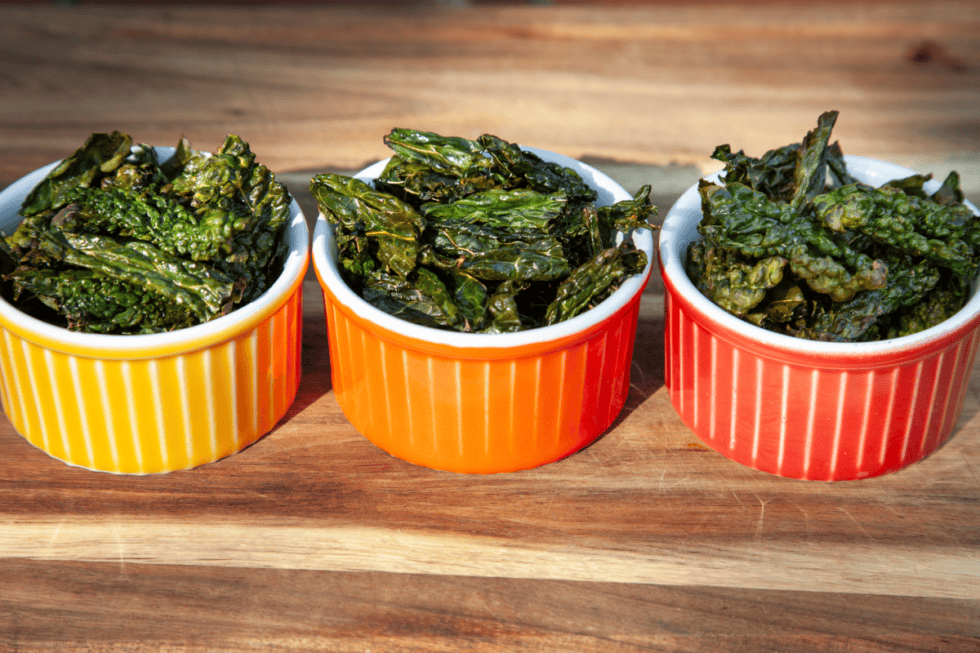
Low Histamine, Low FODMAP Chips (also Low Oxalate, Low Lectin, and Low FODMAP)
If you’re looking for a crispy, healthy snack, check out these low histamine, low FODMAP chips.
This low histamine recipe is for air fryer kale chips.
Kale chips might not sound like a guilty pleasure like potato chips.
And if you’re like some of our friends and relatives, you might think you don’t like kale.
But hear us out!
Kale chips are so popular that you can buy them in the snack aisle of your grocery store.
It’s a healthy alternative to deep fried potato chips.
You’ve probably heard kale is a superfood. High in antioxidants and other nutrients.
But maybe you haven’t tried kale chips because you’ve only eaten raw kale in a salad. And maybe that wasn’t your favorite.
Raw kale can be slightly bitter and tough.
On the other hand, kale chips are flaky, crisp, and a perfect vehicle for your favorite flavors.
Even our skeptical friends and family liked the kale chips we made.
In this recipe, we’ve kept our flavors simple with sesame oil and sea salt. But you can use anything you like.
Making kale chips in the air fryer yielded a super crispy chip in just minutes. We love a quick and easy snack.
Give it a try! We think you’ll be pleasantly surprised!
Read on to get the recipe and learn more about:
- What FODMAP Intolerance is (quick overview)
- Enzymes to help with FODMAP Intolerance
- Top tips for making low histamine, low FODMAP veggie chips
This recipe is:
- Low histamine
- Low oxalate to Medium oxalate
- Low lectin
- Low FODMAP
- Dairy free
- Gluten free
- Vegetarian
Low Histamine, Low FODMAP Chips: A Great Snack for Those with FODMAP Intolerance
Before you change your diet on your own, please make sure you’re working with a healthcare practitioner who can help you with this. Never limit foods unnecessarily, and always have a licensed medical provider who is supervising your case.
The recipes we provide are always low histamine.
This recipe for kale chips is also low FODMAP.
It’s a great snack and easy to make! There’s very little prep involved.
You’ll read a little about FODMAP Intolerance coming up.
But please note that not everyone with Histamine Intolerance has FODMAP Intolerance.
It’s not unusual for FODMAP Intolerance to be seen alongside Mast Cell Activation Syndrome (MCAS). But these two aren’t always related either.
We encourage you to work with a dietitian or other healthcare provider to help make sure you aren’t eliminating foods unnecessarily from your diet.
So, what is FODMAP Intolerance?
Here’s a quick overview along with a resource to learn more.
What Is FODMAP Intolerance?
FODMAPs are short-chain carbohydrates found in some foods.
FODMAP Intolerance is a sensitivity to these types of carbs:
- Fermentable
- Oligosaccharides
- Disaccharides
- Monosaccharides
- Polyols
Common symptoms of FODMAP Intolerance can include:
- Abdominal pain
- Bloating
- Constipation
- Diarrhea
- Gas
- Nausea
- Stomach cramps
These symptoms are related to the digestive system.
They are a lot like the symptoms of IBS (irritable bowel syndrome).
In fact, FODMAP Intolerance is a common occurrence in those with IBS.
Some people get diagnosed with IBS. Then they think all their symptoms are related to IBS. But it could also be FODMAP Intolerance.
But FODMAP Intolerance can happen even if you don’t have IBS.
And as you read earlier, FODMAP Intolerance can also be seen alongside Mast Cell Activation Syndrome (MCAS). Both conditions can have some of the same root causes.
Including an imbalance in your gut microbiome. That’s the balance of good and bad bacteria in the gut.
Related Post: FODMAP Intolerance
A low FODMAP diet is one of the top suggested actions to take if you have FODMAP Intolerance.
But another action that may be helpful is supplementing with enzymes to help break down food and rebalance your gut health.
Rebalancing Your Gut with FODMAP Issues
It’s important you know that this blog post is for informational and educational purposes. It’s not meant to treat any health condition or to be prescriptive for anyone. If you have any medical condition, it is critical you work under the care and guidance of a licensed medical provider.
You just read that one of the main root causes of both Mast Cell Activation Syndrome and FODMAP Intolerance is an imbalance in your gut microbiome.
You might be surprised at everything that can cause imbalances in your gut microbiome.
Have you taken antibiotics lately?
They kill off bad bacteria which may be making you sick. But they can kill off good bacteria, too, creating an imbalance.
Stressed out at work?
Stress can alter your gut bacteria through stress hormones, inflammation, and even changes in your autonomic nervous system (ANS). Your ANS is what controls involuntary bodily functions like breathing.
And did you know that some bacterial species may lead to dysregulated eating?
You might start craving foods that make these bacteria thrive!
Mold Toxicity is another root cause of gut imbalances.
Whatever the cause, if you’ve developed FODMAP Intolerance, you may be following a low FODMAP diet.
But one downside of eating low FODMAP foods is that your body won’t be producing as many SCFAs (Short Chain Fatty Acids).
One type of short chain fatty acid (SCFA) is butyrate. These SCFAs are created when prebiotic fibers are fermented by the bacteria of the microbiome.
Why are SCFAs important?
Read on for more!
The Importance of Short-Chain Fatty Acids
Short Chain Fatty Acids (SCFAs) are extremely important for healing.
Some of the main functions SCFAs play in your body include:
- Modulating certain immune responses
- Anti-inflammatory properties
- Promoting tissue repair
- Strengthening the gut barrier
- Helping balance the gut microbiome
There are different types of SCFAs, but the most beneficial in this regard is butyrate.
Butyrate has also been shown to support mast cells.
If you are eating a low FODMAP diet, you can see why you’d want to supplement SCFAs. Especially in regard to helping balance the gut microbiome and supporting mast cells.
Tributyrin-X™ is our preferred butyrate supplement.
Tributyrin-X™ is FODMAP friendly.
You won’t see high FODMAP ingredients on the ingredient list, unlike some other brands of butyrate supplements.
Related Post: The Best POST-biotic Butyrate for Mast Cell and Histamine Supports
If you’d like to try Tributyrin-X™, we’ve got a coupon code for you!
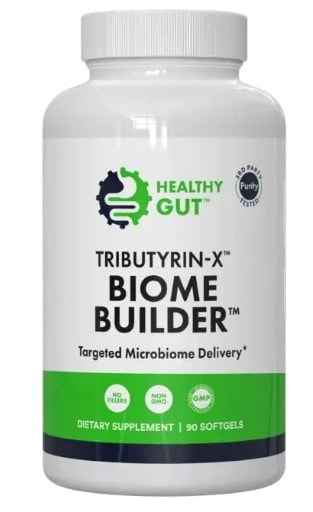
>>> Use code MASTCELL360 to save 15% and try Tributyrin-X Biome Builder today!
One final note of encouragement for you.
If you are dealing with food intolerances like FODMAP Intolerance, take a moment to thank yourself for making the good choices you’ve made to support yourself.
Whether it be through diet or supplements, or even just being gentle with yourself today, you’ve done something positive towards your healing.
Good job!
Ready to make a low FODMAP snack?
Here are the tips you don’t want to miss.
Top Tips for Making Low Histamine, Low FODMAP Chips
Walk down the snack aisle at the grocery store and you’ll see tons of crispy, yummy snack options.
Potato chips, sweet potato chips, corn chips, corn tortilla chips, gluten free pretzels, rice crackers…you name it!
But processed foods in general are not a great choice when you’ve got sensitivities and mast cell issues.
Additives and preservatives can be triggering.
Deep fried foods aren’t a healthy option.
And even high-quality, commercially prepared snacks and chips may have ingredients you can’t tolerate at the moment.
Kale chips are no exception.
One brand that looks good for the most part, still has orange juice, lemon juice, garlic, sesame seeds, and more.
If you are very sensitive, even small amounts of these ingredients may cause reactions due to histamine, oxalates, lectins, FODMAPs, or even salicylates.
Of course, everyone is different in what they can tolerate.
That’s why preparing your own snacks can be helpful for your health. And every bit as tasty!
Here are our top tips for making these low histamine, low FODMAP kale chips.
- Start with Lacinato (aka dinosaur) kale to keep this recipe lower oxalate.
- Remove woody, thick stems and discard.
- Cut the leaves into about 2 inch pieces (that’s about as long as the tip of your finger to the second joint).
- Follow instructions for your air fryer since each air fryer is different.
- It can help to use the preheat setting on the air fryer. Don’t add the kale until the preheat is complete. Then add kale leaves and cook as directed (about 4 minutes total).
- Place the leaves in a single layer in the air fryer (some slight overlap is fine). You may need to cook in batches depending on how large your unit is.
- Toss the chips 1 time about halfway through cooking for a more even cook.
Don’t have an air fryer? You can make this recipe in your regular oven.
You’ll cook at a lower temperature and for a longer time.
We’ve had success at about 300° F for about 20 minutes total. (Stir them around at about 10 minutes for a more even cook.)
Again, each oven is different, so keep checking to prevent burning.
Enjoy!
More Low Histamine, Low FODMAP Snacks
- Macadamia Nut Butter – Medium Oxalate, Low Lectin
- Candied Ginger Pecans – Medium Oxalate, Low Lectin
- Sorghum Popcorn – Low to Medium Oxalate, Low Lectin
Low Histamine, Low FODMAP Chips (also low oxalate and low lectin)
Equipment
- Sharp Knife
- Air Fryer *see notes for oven instead
Ingredients
- 1 bunch Fresh Lacinato Kale about 5-6 ounces
- 1½ Tablespoons Toasted Sesame Oil
- ½ teaspoon Redmond Real Salt
Instructions
- Preheat your air fryer to 360° F.
- While the air fryer is heating, wash the kale and remove woody, thick stems and discard.
- Cut the leaves into 2-inch pieces (approximately).
- Pat off any excess moisture with a clean dish towel or paper towel.
- Put leaves in a bowl and toss with sesame oil and salt.
- When the air fryer is ready, add the leaves in a single layer to the air fryer and cook for 2 minutes.
- Toss the kale leaves at the 2-minute mark and cook for another 2 minutes.
- When done, the leaves should be very crispy but not burnt. Some color changes may occur. Just don’t overbrown or burn, to prevent bitterness.
Notes
Nutrition
Let us know if you liked the low histamine, low FODMAP chips made in the air fryer by leaving us a comment! We loved how fast it was compared to the oven!
More Low FODMAP Recipes
- Chicken Marinade Skewers – Low Histamine, Medium Oxalate, Low Lectin
- Low Histamine Spring Roll Stir Fry – Low Oxalate, Low Lectin, Low Salicylate
- Tacos – Low Histamine, Low Oxalate, Low Lectin, Low Salicylate Option
The website provides approximate nutrition information. Users should calculate the nutritional information with the actual ingredients and quantities they use in their recipes for the most accurate representation.
Some links in this website are affiliate links, which means Mast Cell 360 may make a very small commission if you purchase through the link. It never costs you any more to purchase through the links, and we try to find the best deals we can. We only recommend products that we love and use personally or use in the Mast Cell 360 practice. Any commissions help support the newsletter, website, and ongoing research so Mast Cell 360 can continue to offer you free tips, recipes, and info. Thank you for your support!
References
Folkerts, J., et al. (2020). Butyrate inhibits human mast cell activation via epigenetic regulation of FcεRI-mediated signaling. Allergy, 75(8), 1966–1978. https://doi.org/10.1111/all.14254
Madison, A., & Kiecolt-Glaser, J. K. (2019). Stress, depression, diet, and the gut microbiota: human–bacteria interactions at the core of psychoneuroimmunology and nutrition. Current Opinion in Behavioral Sciences, 28, 105–110. https://doi.org/10.1016/j.cobeha.2019.01.011
Shin, Y., et al. (2023). Roles of short-chain fatty acids in inflammatory bowel disease. Nutrients, 15(20), 4466. https://doi.org/10.3390/nu15204466
Starting the low FODMAP diet – Monash FODMAP. (n.d.). Monash University. Retrieved July 1, 2025, from https://www.monashfodmap.com/ibs-central/i-have-ibs/starting-the-low-fodmap-diet/
Venegas, D. P., et al. (2019). Short chain fatty acids (SCFAs)-Mediated gut epithelial and immune regulation and its relevance for inflammatory bowel diseases. Frontiers in Immunology, 10. https://doi.org/10.3389/fimmu.2019.00277


Add A Comment